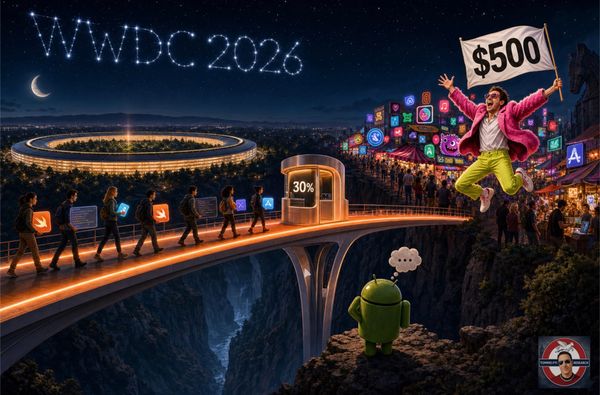
Apple, Horace Dediu, And The Twenty-Year AAPL CAGR Ploy
Apple Bull Horace Dediu Once Dismissed Buybacks, Dividends and Splits. Now His 20-Year AAPL CAGR Argument Depends on Them. What a difference sixteen years makes, and how does looking in the rear view mirror, really inform what’s coming up ahead?

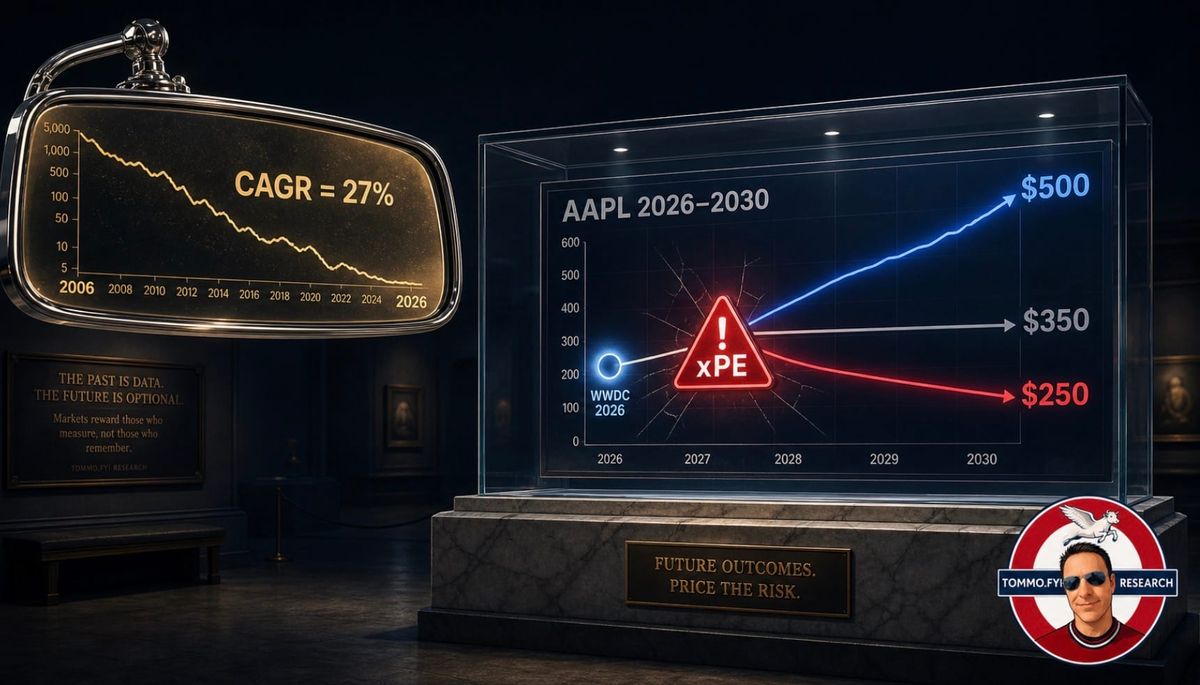
There is a particular kind of financial commentary that wears sophistication like a good coat — tailored and reassuring — yet when you finally put your hands in the pockets, they turn out to be empty.
Horace Dediu's latest use of Apple's 20-year compound annual growth rate (CAGR) belongs in that category.
Part of his new note refines that serenity into a kind of comfort doctrine: twenty years of 26.6% CAGR in earnings, 27.7% in the share price, a billion-plus users and he proclaims that in The Book According to Dediu, dissent from this view of never-ending growth is futile and irritatingly stupid.
He proceeds to place the onus on the doubter to produce “extraordinary evidence” to counter him in a languid display of hubris and challenge. Let’s take a dive into this back-to-the-future piece, but first a quick reminder of what happened way back in the early days of Apple’s re-ascendence after the iPod hit a home run and a rummage through the 2010 archives.
The 20-Year CAGR as Museum Label
This report asks whether AAPL’s 20-year backward looking CAGR is being misused as a forward valuation argument, and whether buyback-driven EPS mechanics are now weakening enough to change the stock’s return profile even if Apple remains highly profitable.
Between 2005 and 2012:
Apple moved from iPod to iPhone to App Store to iPad with a speed that makes today's pipeline look geriatric and accident prone, and from a valuation base that presumed failure every year. This was a 10 times earnings multiple on a company growing earnings at 70% and the market was not just wrong; it was categorically wrong which is why I remained so heavily invested in AAPL. The upside was self-evident to anyone with or without a brain – except for Rob Enderle et al who thought “The iPod Company” would die a death “next year,” every subsequent year.
Horace himself said as much on Christmas Day, 25th December 2010, writing for Asymco under the heading "Apple Now Trading at 10 Times", concluding — “after years of thinking about it” that the only explanation for Apple's then-depressed multiple of 10x was CEO-succession anxiety about Steve Jobs.
My reply at the time was that he was ignoring an entire system of forces around Apple's sticker price.
He resorted to saying that was his opinion, and wouldn’t be drawn any more. In sixteen years, it’s evident not much has changed reading his new note (more on that later) compared to his past musings.
Read the full 2010 exchange for yourself in the link below but here are a few edited highlights:
 December 25, 2010 at 4:14 pm
Dediu’s 25th December 2010 rather bleak Christmas Day Message
Horace:
“The revenue growth rate is expected to continue at 66% (following 61% and 67% for previous two quarters). Earnings growth is also expected to be maintained at 70% as it has been over the full calendar year. Apple continues to be one of the cheapest stocks in the S&P 500 when measured by growth multiples. After years spent thinking about it, I can only conclude that the company’s depressed valuation is due to the uncertainty surrounding the CEO succession plans.”
Me:
“Horace, I'm dumbstruck by your little missive. I thought you were an incisive analyst, not an armchair prognosticator. I'm not going to do or say anything specifically in response to what you wrote because I don't want to perpetuate this macabre topic any longer, but colour me disappointed that on Christmas Day the most interesting thing you could think of to write about Apple, ended up being a Rob Enderle style throwaway comment about Steve Jobs and his health.”
Horace:
“It's not a throwaway comment. I have thought about it a long time[…] I am as optimistic about the company's future as he is [who? Rob Enderle?]. My point is that there are no valid fundamental reasons for the low price.”
Me [heavily shortened]
“You state quite firmly that "having spent years thinking about it, I can only conclude.." etc.. I respectfully completely disagree with you.. I'd be far more interested to hear your thoughts and some incisive analysis showing how:
- A 10:1 split and the issuance of a tiny dividend might impact the stock, especially following the likely outcome of the Nasdaq being forced to rebalance the index thereby diluting AAPL's influence on it and thus the market
- What boost might the stock being bought by dividend-yielding mutual funds have?
- Do you not agree that post-split, AAPL could jump from $30-ish to $40 in a flash, whereas $300 to $400 seems like an incredible challenge?
- Mightn’t it be simple psychology preventing AAPL [due to its then-high sticker price] rising to its true value, rather than anything so esoteric as concerns over a succession plan?
‘I simply cannot agree with your conclusion that it is the market's lack of awareness of Apple's succession plans which is holding the stock back.’”
Horace:
“The point I'm making is that there is no other explanation that I can come to [than fears about Steve Jobs’ health]. I don't believe dividends, buybacks, splits would affect the P/E.[my emphasis] The only other explanation I've heard was that the growth is not sustainable, but that's been put forward for a long time, and growth does not seem to be letting up (and is fairly easy to forecast.)”
Re-read that statement again:
“I don't believe dividends, buybacks, splits would affect the P/E.” – H.D. 2010
For the last decade at least, especially by Dediu, it’s been widely recognised that without the benefits gained from:
- buybacks retiring almost 50% of outstanding shares giving earnings-per-share such a boost,
- long-term investors buying into the security of dividends, and
- the splits to attract new money,
… it could easily be argued that AAPL would be not have been over $200 now, thanks in no small part to EPS dilution sans buybacks.
The man who once dismissed buybacks, dividends and splits as irrelevant to the multiple is now using a 20-year CAGR heavily shaped by capital-return and multiple-regime changes to dismiss today’s sceptics.
Fast-forward to June 2026
The argument is the same argument, but mirror-inverted. Ten times earnings and 70% growth was the setup in 2010. Roughly thirty-five to forty times earnings and 12% growth is the setup now. Thanks to an FYI reader who sent me a snippet from one of Dediu’s missives, it seems he’s indulging in the same kind of languid reductionism again:
“Over the last 20 years, Apple’s CAGR equals 26.6%, and its share price has compounded at 27.7%. And yet, 42% of analysts rate it a hold or sell, and 10% don’t even rate it.”
He ends the note with this statement in three parts:
“The sceptical claims have not presented extraordinary evidence. The strongest has been that if AI can create an alternative to the user interface Apple pioneered, and if Apple would not be incentivized to embrace this new paradigm, and if enough users would abandon the comfortable and familiar digital life Apple affords them then Apple would slow or stagnate.
There are a lot of “ifs” in this argument. Each more dubious than the other.
In contrast, the “flywheel” or momentum of serving 1.3+ billion users with iris-dilating products and services provided at premium positioning seems self-explanatory. That almost 40% of the analysis covering Apple believe that it cannot deliver above-index average growth continues to amaze me.”
Let’s deconstruct this backward-looking CAGR relic and address those inconvenient “ifs.”
Because this is where the argument starts to unravel, but first to be clear, this article is not about Horace Dediu or a critique of him. He is useful here because his note expresses the current AAPL comfort case in its cleanest form: ” long-term CAGR, vast installed base, self-explanatory flywheel, and sceptics asked to bring ‘extraordinary evidence,’” before they are allowed to disturb the room.
Having cleared that up, I’m reminded of the dragon, Smaug, in The Hobbit, lying smugly asleep and lazily confident in his invincibility on his horde of gold, not knowing there’s a glaring vulnerability in his armour, and proceeds to die a miserable death in a lake after a lucky shot from a keen archer with a sharp eye.
The lazy narrative being pompommed around AAPL is becoming something closer to comfort food served with a large Slurpee, than meat you can sink your teeth into.
Comfort is not analysis, and a long historical return is not a forward model simply because it has behaved beautifully in the rear-view mirror. When this level of complacency glows, it shines a light on what’s pretending to be intellectual make-up and when you scrape hard, the 20-year CAGR ploy now being offered as reassurance may itself be concealing underneath it the mechanics that make the stock vulnerable from here once you remove the previous, unique, drivers:
- the underpriced hypergrowth era,
- the Services rerating,
- the multiple expansion,
- and the buyback-assisted EPS regime helping AAPL look like a cleaner compounding machine than the underlying business alone could have come close to.
This is astonishingly clear to see once you look for it, and hard to unsee once the numbers are plugged into a spreadsheet.
I’ve done the math and will be publishing a deep analysis at a later date but suffice to say, there is a staggering reveal to come. In a nutshell, past performance is no guarantee of future growth and this time, it’s not just rhetoric.
The Relay Race He Is Misrepresenting As A Single 20-Year Long Sprint With No Changes
The 20-year CAGR story is not one continuous phenomenon as it is portrayed, as if the events which took place within it were anything other than absolutely extraordinary.
It is a blended relay race in which one engine handed off to another roughly every four to six years, and none of those engines is currently available in its original form. Importantly, nor is there an immediately new and novel engine visible to drop in (Apple Intelligence subscriptions have yet to be anything other than a pipe dream, albeit one I modelled – including an App Store – last September 2025).
To treat the overall compounding effect as a single forward-projectable signal is simply an enormous error. The date range is doing half the work. Let’s look at those stages:
2005–2012: The Slingshot
iPod to iPhone to App Store to iPad, from a 10-to-12 times multiple. Revenue expected at 55-66% growth, earnings near 70%. The market was underpricing the business because it did not understand the business, and when it started to understand, the re-rating was violent. That kind of compression-to-decompression is a once-in-a-generation event for any franchise. It is not repeatable from a 37-to-40 times starting point. The return from this era combined explosive earnings growth with multiple expansion from absurdly low to merely low — a double engine that is arithmetically impossible to replicate from today's starting valuation.
2013–2018: Maturity Anxiety and the Buyback Decade Begins
iPhone dominant but saturating. Peak iPhone talk arrived early. China risk, carrier-dependency risk, the recurring question of what comes after the slab. The investment case shifted quietly but materially from category explosion to capital return and ecosystem durability. Buybacks became increasingly important. The stock moved, but the engine was different — it was less about earning the next multiple and more about defending the existing one through relentless share-count reduction.
2018–2021: Services Re-rating
Apple's FY2018 10-K showed Services net sales of $37.19bn, up 24%, and 14% of total net sales; the filing noted that Services growth was driven primarily by licensing, the App Store and AppleCare. Around this period, investors began separating Services as a high-margin recurring engine, not a line item attached to hardware.
The same App Store, the same licensing, the same AppleCare — now valued like a subscription machine rather than an accessory. Apple's Q1 2019 earnings call made the capital-return machine equally explicit, with Luca Maestri stating that Apple had returned over $13bn through dividends and buybacks in the quarter and was continuing to target a net-cash-neutral position over time. The stock began trading less like cyclical hardware and more like an ecosystem-plus-services annuity. The PE, on one historical dataset, moved from 12.2 times at year-end 2018 to 22.2 times in 2019 and 34.6 times by year-end 2020.
2020–2024: Multiple Expansion, Pandemic Liquidity, Institutional Comfort
This is where the PE tells the story most starkly. Year-end PE estimates across this period run roughly: 34.6x in 2020, 28.6x in 2021, 21.6x in 2022, 29.6x in 2023, 39.5x in 2024, 34.3x in 2025. A huge portion of the later share-price performance came from multiple expansion, not underlying business growth. The business did not earn a 40 times multiple because it was suddenly a faster grower — net income in this period compounded at roughly 10-12% per year. It earned the multiple because capital was cheap, alternatives were scarce, and Apple had become the most institutionally comfortable name in the market, from being a high performing but risky outlier.
2025–2026: AI Premium and Execution Risk
Apple now trades at a historically rich multiple — around 35 to 40 times trailing earnings depending on the week — while its AI execution remains genuinely unresolved.
Strip out buyback support and organic earnings growth runs at roughly 11%. Does that deserve a fPE rising to over 40x ?
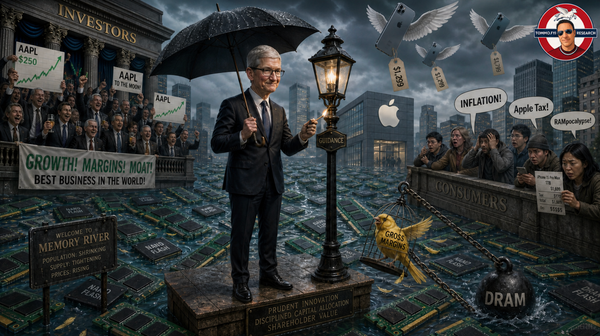
R&D and infrastructure spend are rising. The buyback mechanism that silently turbocharged EPS for a decade is losing its force and being cut back.
But this is not 2010. AAPL is not underpriced growth waiting to be discovered.
It is a fully loved mega-cap that needs to prove the next growth engine exists before the market stops paying for the one it has already priced in, and at the moment there is no narrative, just a string of failed product launches, a botched entry into AI which has cost it both supremacy and control over the rollout of it within its user base, and the hope – just a hope – that the company will devise a clever way to monetise it very quickly. That’s a big ‘if’ to hold that weight and hope.
Dediu’s “Ifs” That Are No Longer Ifs
The current comfort argument dismisses the Apple AI bear case as a chain of increasingly far-fetched conditionals: if AI creates an alternative interface, if Apple refuses to embrace it, if users abandon their comfortable digital lives. The difficulty is that at least three of those conditions are already in motion.
On interface: systems like ChatGPT, Claude and Perplexity are no longer occasional tools. They are becoming working environments — places where people build project memory, store research archives, draft decisions and maintain context across weeks and months. That context does not live in Siri. It does not live in Spotlight. It lives somewhere else, and Apple has no claim on it.
On sovereignty: Apple’s original Apple Intelligence positioning assumed first-party models, sealed inside the hardware-plus-Private-Cloud-Compute stack. The company has already compromised that position by turning to Google’s Gemini technology as a foundation for elements of Apple Foundation Models, while maintaining the privacy framing around Private Cloud Compute. Call it “pragmatic adaptation” if you want to be kind. It is not the self-contained AI moat the initial narrative implied.
The larger concession is more structurally significant than most commentators have noted
On third-party AI selection: Apple’s new implementation of Apple Intelligence will (yet to be announced but all but confirmed) allow users to select Claude, Gemini or other services for Apple Intelligence and Siri functions. By the time this is published, WWDC 2026 on 8th June will have confirmed or denied this. Either way, the direction of travel is plain: Apple is building bridges and tunnels across what was supposed to be a moat.
Apple’s apparent decision to allow any major LLM to operate within Apple Intelligence — connected to a user’s account, accessing their threads, projects and years of accumulated context — is not a feature to crow about. It is a surrender flag, and an acknowledgment that users have already built cognitive lives outside iCloud beyond Apple’s reach.
More importantly it is proof that Apple is no longer a container of ready-to-spend subscribers on Apple AI subscription models, but a conduit for others.
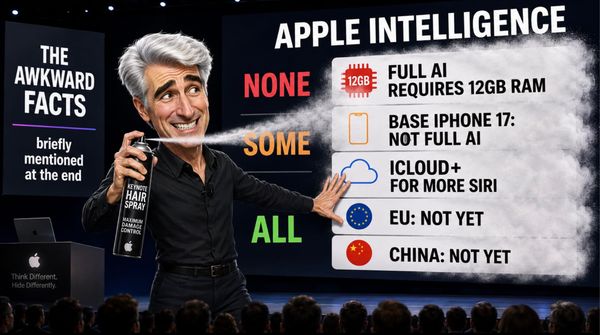
This really does matter: the hardware and OS interaction layer through which users reach work that lives somewhere else entirely, on other AI platforms. By their inept launch of Apple Intelligence and a two to three year delay on its launch (unless by some miracle, WWDC 2026 delivers something other than a staging post towards “more to come, later in 2027”) Apple have already lost the control of their own narrative and the ability to define AI and the prospect of what an agentic OS might be, to others now years ahead of it.
Catching up is not leadership, after all.
It is a first amongst many equals much like the Maps project in 2010 let Google forge ahead, and left Apple Maps as an eventually competent but not leader, in the nascent but vital domain of not just sat-nav but identifying points of interest, monetising maps (something it is only now, 15 years later, beginning to do, and most of all offering a product people actually want to use instead of Google Maps.
Many will keep using their preferred LLMs outside of Apple Intelligence, even if they use their Apple hardware to access them, because those workflows are now stitched into their day‑to‑day lives. It could reasonably be argued that Apple has squandered the once‑only opportunity to embed itself as the default cognitive layer for its 1.3 billion users through simple inaction and incompetence.
Some gen‑AI tasks will run through Apple Intelligence, certainly, but it is optimistic to imagine people uprooting years of projects from existing LLM environments and relocating them wholesale into Apple’s. What happens within Apple’s garden is likely to be low-level inference, not high performance longitudinally important threads and relationships many have built up with the LLM platform of their choice, and it’s worth noting that there are now more ChatGPT “installed users” than there are iOS devices.
Apple has, to put it mildly, blown that opportunity in spectacular fashion — and much of the “easy money” is already flowing to OpenAI, Anthropic, Perplexity and others via subscriptions that sit outside Apple’s tower.
The root of this failure is not recent or the failure of the 2024 Apple Intelligence promise.
Apple bought Siri in 2011 and spent sixteen years not building with it — missing the window to put a genuinely agentic assistant into its OS stack at a time when no one else was close. That may prove to be Apple’s costliest strategic error since the 1990s decision to license MacOS to third party OEMs and suddenly found its own hardware undersold with Macs that often vastly overperformed its own.
 Tommo_UK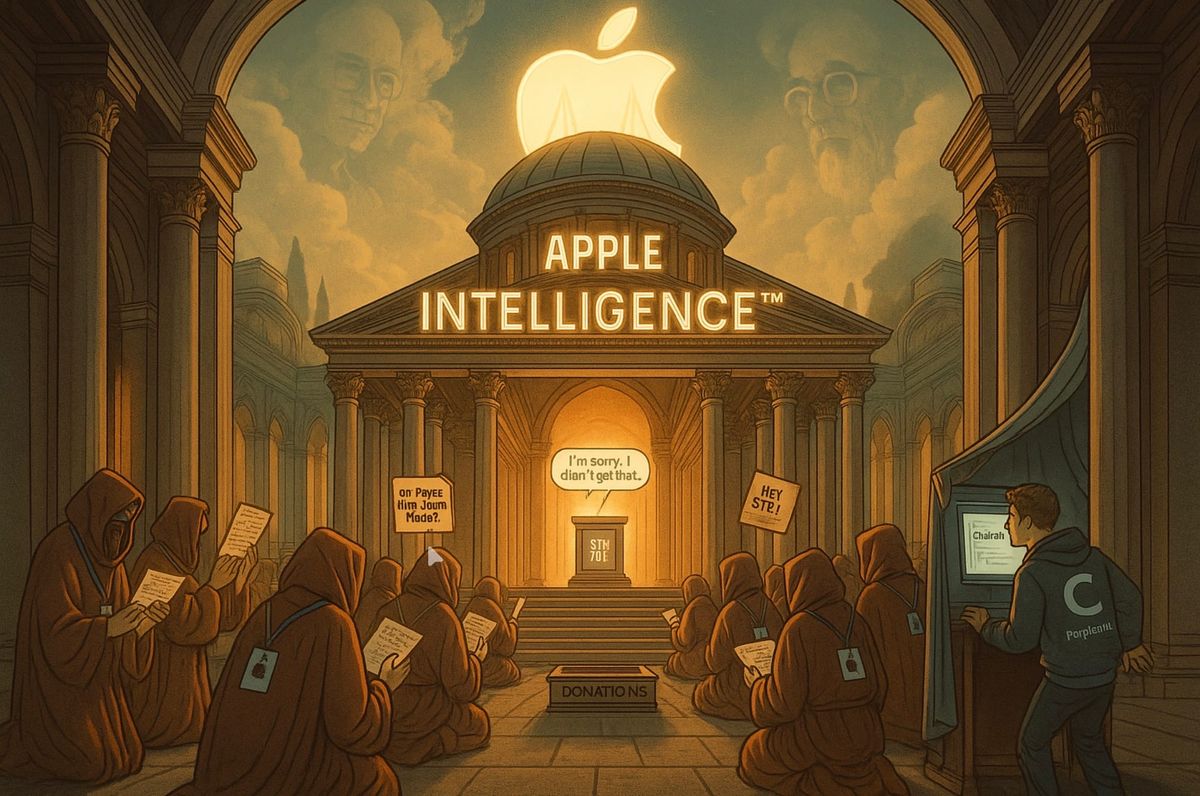
My July 2025 deep dive into the real reasons behind Apple’s Siri self-inflicted disaster.
Similarly, the genAI industry did not sneak up on Apple; it walked in through the front door while Siri was still struggling to set a timer reliably, and Apple in its haste to catch up, lost two years and several demographics to ChatGPT in the process.
The Harsh Truth About The “Twenty Year CAGR Story”
The Apple 20-year CAGR celebration is not false. It is worse than false if used carelessly: it is true in a way that conceals the mechanics. It blends underpriced hypergrowth, multiple decompression, Services re-rating, liquidity-era multiple expansion and buyback-assisted EPS growth into a single comfort-statistic, then asks readers to project it forward from the opposite starting point.
What remains is the question no 20-year CAGR can answer:
Does anyone still want to pay a forty-times price for a business that has already used all those engines, and will it be AAPL at $500 by 2029 with a fPE of 40, or $310 if the multiple gradually retreats to a still high-end historically, 28 times?
Fascinatingly, both are actually plausible and both account for good growth. Or in short, “it’s the multiple, stupid.”
At $310 in 2029, AAPL would just be returning to the norm of the multiple from what would otherwise be an unsustainable 43x – unless you believe the company, without the benefit of a buyback tailwind, is going to deliver sustainable growth of 20-25% YoY.
The full fundamental and quantitative analysis, designed to shine a light on the next five years rather than bask in the sun of the last two decades, will follow soon in PDF format.
It will not be posted as a standard article or public download. FYI subscribers will receive it directly in their inbox. In twenty-five years of writing about AAPL, I think this may be one of the most valuable pieces I have put together. Sign up free and it will land straight in your inbox
If you’d like to receive this 25,000 word deep dive with tables and the maths, in your inbox by PDF, please sign up for free using the button below.
Note: If you are already a member, but de-subscribed from the newsletter, you will need to re-subscribe to it to access this article. Just go to Account settings and re-enable the Newsletter
In the meantime, Horace, I wonder if you have something to add? Drop me a line in the comments, or I’d be delighted to give you a right of reply, if you’d like, in a follow up piece.
Tommo_UK, London, Thursday, 4th June 2026
© 2026 Tommo_UK / tommo.fyi
Follow me on X:
www.x.com/tommo_uk
Connect with me on LinkedIn:
www.linkedin.com/in/tommo-uk
CONTACTING ME
💡 Reach out to me using the Confidential Drop Box form below.

CONTACT ME DIRECTLY: discreetly (and anonymously if you prefer)