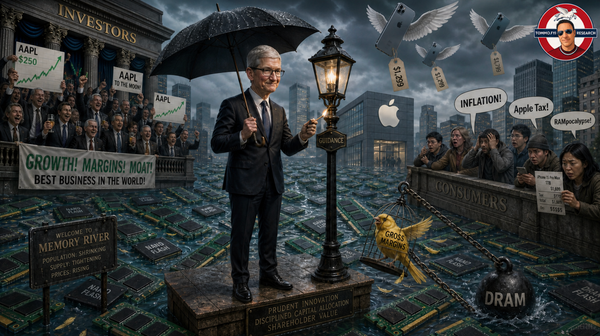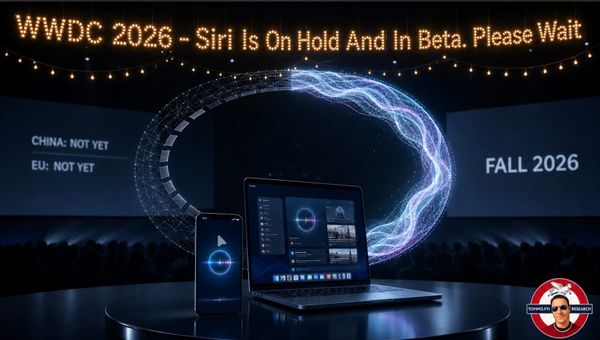
Apple’s Real “One More Thing:” WWDC’s Possible Hidden ‘SWIFT’ Path to a $500 AAPL.
A better Siri would calm investors, and bore everyone else. But an App Store for Android and an AI token-free zone for developers to build their apps would change the story, and lay a Golden Path for Apple’s dev kit to become the dominant multi-platform development environment.

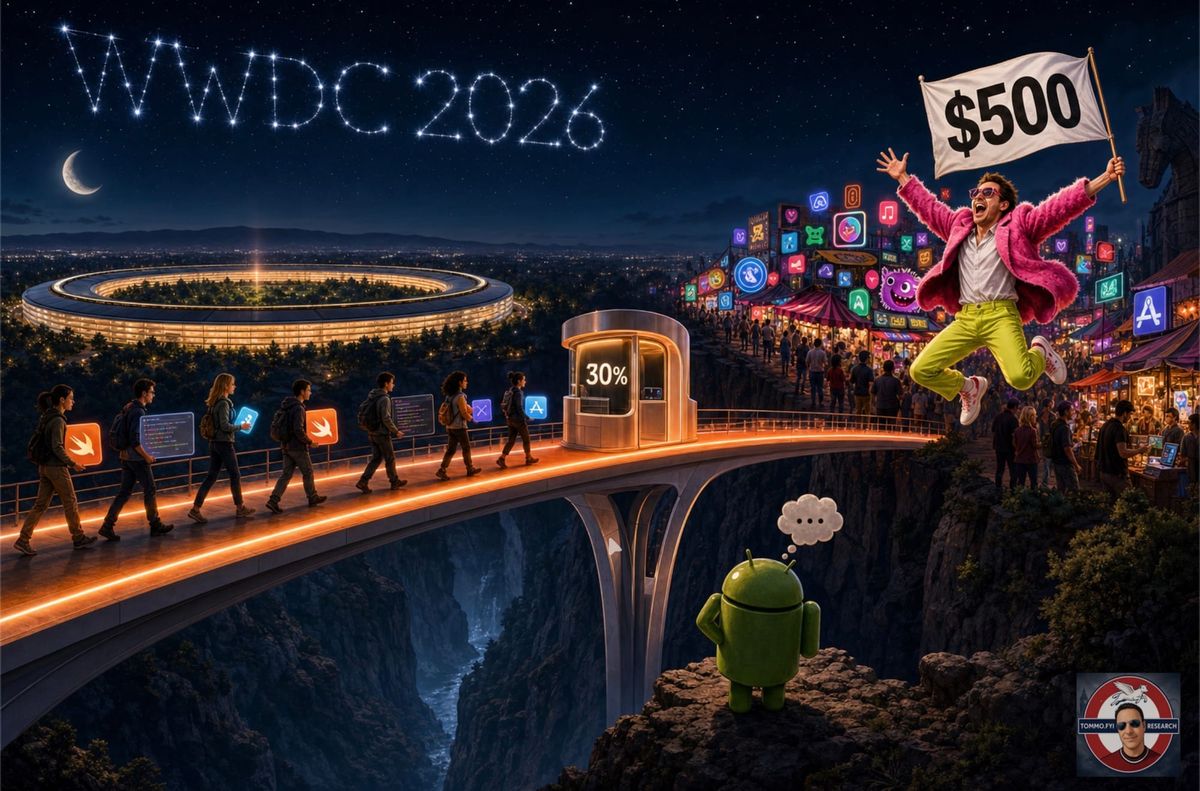
The most important announcement at WWDC may have nothing to do with Siri finally behaving well enough to book a restaurant, summarise a document or survive the usual keynote parlour trick of making software look obedient for four minutes under studio lighting.
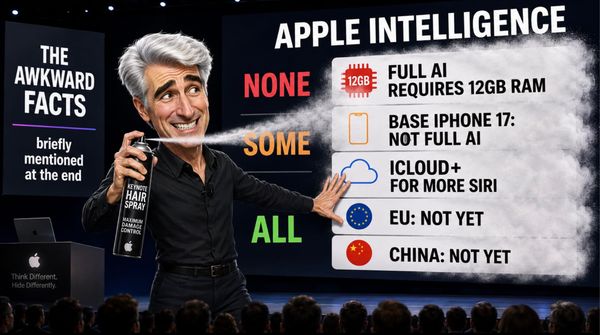
That’s if Apple can deliver for developers and not just lay on a fancy CGI fest all hairspray and no substance.
Exec Summary of this article:
Apple’s real WWDC opportunity is not a slightly less useless Siri, but a developer‑first move that turns Swift/Xcode into a serious AI‑assisted, cross‑platform dev environment.
- In that model, developers write primarily in Swift, use Apple’s local + cloud AI tools without per‑token costs, and have Xcode generate and maintain both iOS and Android builds.
- Apple then extends the App Store to Android as a trusted storefront, handling payments, subscriptions, and safety – giving Android users an “Apple layer” without forcing a device switch.
- This reframes the 30% App Store fee as payment for tooling, distribution and trust rather than a monopoly toll, easing regulatory pressure while expanding Services beyond the installed base.
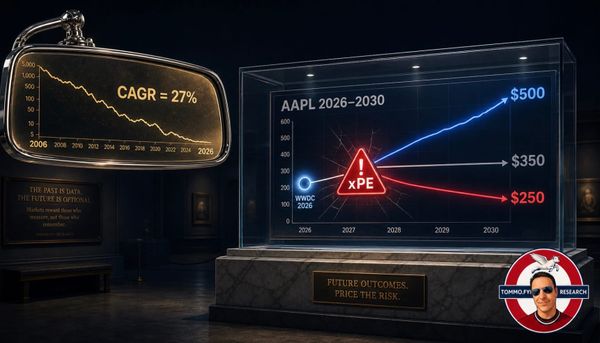
- If Apple executes, this developer‑centric “One More Thing” could be the missing strategic story that takes AAPL beyond the current $400 debate towards a credible $500 path by 2027.
Introduction
Apple certainly needs Siri to work, because there are only so many years a company can describe intelligence as central to its future while its most famous assistant remains the product equivalent of a lobotomised care home patient who occasionally answers back. Yet a better Siri, however welcome, would mostly show that Apple has finally reached the front of a queue the rest of the industry has already been moving through for years. In other words, what might delight Apple users, has been the norm for everyone else for some time now.
The real surprise might be quieter, harder to explain in a consumer demo, and much more suited to a WWDC developers event — and far more consequential:
Apple using AI to change how developers build software, how much that work costs, where it can be distributed, and how Apple earns from the whole process.
Xcode, Swift, Apple Silicon, local models, Private Cloud Compute, App Store Connect, payments, subscriptions, review, privacy labels and the App Store’s remaining trust advantage already form the outline of a larger strategy.
The market is currently focusing on whether Apple has a Siri answer. It does - it’s called Google’s Gemini which has been transplanted into Siri and will run Apple Intelligence. Snark aside, that’s now a done deal, so I won‘t repeat my own position about Apple’s caving-in to its own incompetence and landing up years behind the industry after having had a sixteen year head start
The better question is whether Apple has a developer answer.
And how that might take the stock up to $500, not $400, in short measure.
A year ago I laid out how AAPL could reach $400 by Q1 2027 if Apple turned its creaking OS stack and AI ambitions into a modern agentic system.
This piece pushes the same logic further: if Apple can make developers the centre of WWDC, the more interesting number may not be $400 at all.
 Tommo_UK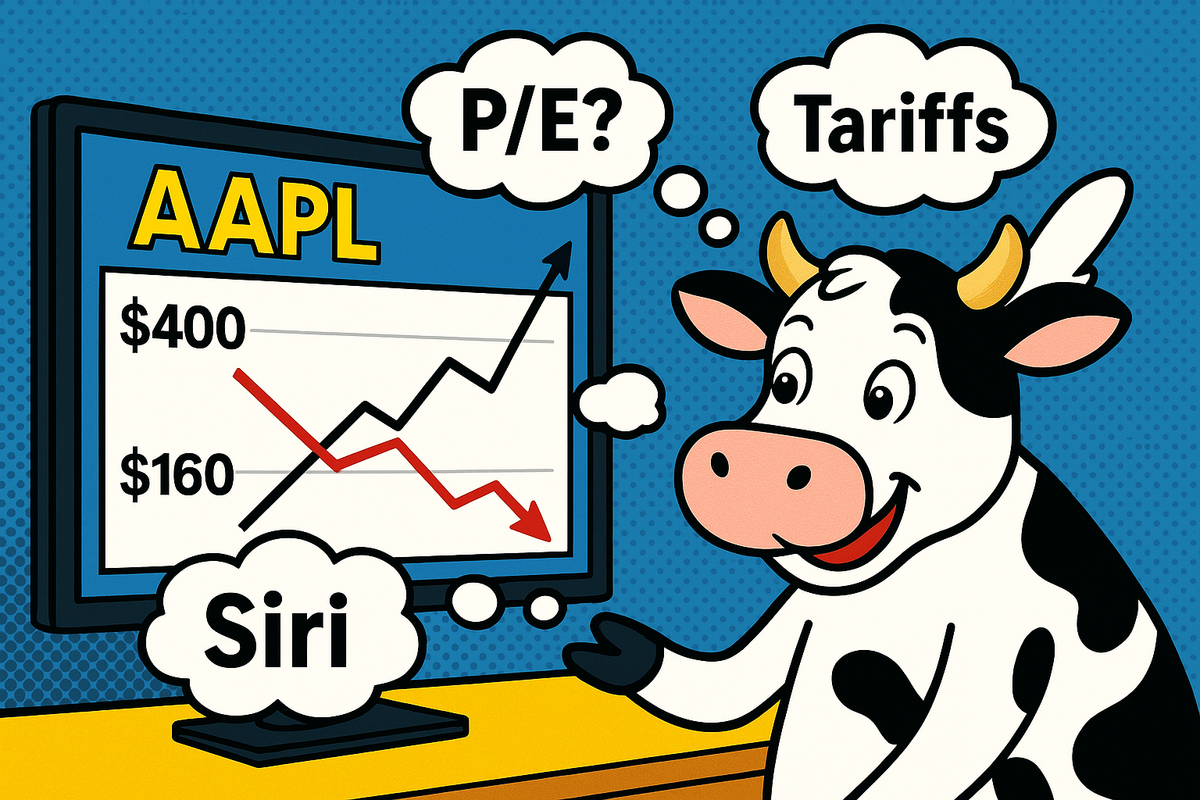
The second of many articles where I speculated about Apple purchasing Perplexity in June 2025, charting how and why using it to connect the bare plumbing of Apple’s FMF and PCC services could give in a 12 month head start again. Sadly we’re back at square one now, but Apple seem to have gotten the message: an agentic OS is the future.
The hidden path may be to $500, not $400 by the end of 2027.
If you’d like to read the rest of this article, free of charge but for providing your email, just press the button and select the free tier option. You’ll receive articles direct to your inbox. Don’t worry, you can turn off this feature later, if you don’t want notification.
Note: If you are already a member, but de-subscribed from the newsletter, you will need to re-subscribe to it to access this article. Just go Account settings and re-enable the Newsletter!
That distinction is really important to ponder on for a moment because WWDC is, at least in theory, a developer conference.
WWDC 2026 runs from June 8 to June 12, and the event is widely expected to focus on platform updates, AI and developer tools, with investors still watching for signs that Apple’s AI delay was a temporary stumble rather than a cultural condition.
- A consumer-facing Siri revival would be the obvious headline.
- A developer-first platform move would be the actual shift.
WWDC has been allowed to morph, in recent years, into a corporate love-in with consumers and CGI presentations. It needs to get back to its roots and deliver real innovation and opportunity.
 Tommo_UK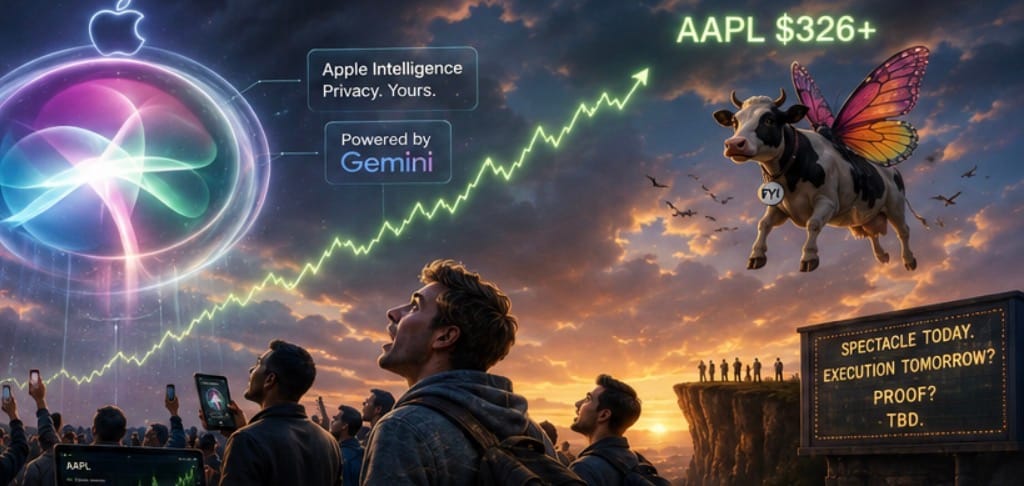
A credible version of my path to $500 begins with Apple’s developer environment, SWIFT.
Apple has spent years treating Swift as the natural language of its own platforms, while the mobile software economy has continued to live across iOS and Android. Every developer who wants reach has had to choose between duplicated work, compromise frameworks, parallel teams or the familiar cross-platform bargain in which the product works everywhere while belonging properly nowhere. The alternatives are web apps which nobody likes.
AI gives Apple a way to attack that cost without pretending the two platforms are the same.
Developers could write the heart of an application in Swift, describe interface intent and product behaviour inside Apple’s tools, then use Xcode’s AI agents to adapt, test and maintain iOS and Android versions where each platform needs different treatment.
This would not be the tired old “write once, deploy everywhere” promise with a fresh badge and a makeover. Developers have been burned often enough by that pitch to smell smoke before the demo ends. The more honest offer would be better:
- write in Swift,
- keep Apple-quality behaviour where Apple quality matters, and
- let the tools remove enough Android duplication to make wider release cheaper, faster and less punishing.
Write once in SWIFT, deploy across iOS and Android? “Heresy!” I hear you’d say.
But, there are early signs already pointing toward parts of this, even if the full strategy remains speculative. Apple opened its on-device foundation models to developers in 2025, giving apps a way to use Apple Intelligence locally for private, offline features.
Xcode has also moved deeper into agentic coding - Xcode 26.3 integrates OpenAI’s Codex and Anthropic’s Claude Agent so they can work inside projects, edit code, change settings and search documentation directly, while also adding support for Model Context Protocol enabling simple connectors to external platforms and cloud apps.
Meanwhile, Swift’s wider ecosystem has been edging toward Android, with public references to Android support and a reported Swift Android SDK preview in late 2025. None of this proves Apple is about to announce a Swift-for-Android moonshot, but it makes the larger question fair:
why would Apple not at least be considering it?
The obvious reason is cost.
AI-assisted development is becoming powerful, but it is also becoming another bill: subscriptions, usage limits, cloud inference, model access, privacy exposure, context windows and the hidden labour of checking output that is useful without being safe to trust unsupervised. The AI industry is changing rapidly and the free and cheap tiers for consumers may be about to undergo significant changes, including pay-per use models and developers are screaming to lower costs using AI-powered dev kits. That’s why when OpenClaw and Perplexity’s Personal Computer launched, which can be run on a Mac Mini locally with no need to pay a AI company for token use, the cost/benefit of dropping $1500 on a new Mac mini setup would easily pay for itself in a few weeks (or days in heavy development), and avoid rising token costs making deep AI coding tasks increasingly unaffordable
Large companies can absorb that as the new cost of speed. Small teams, students, solo developers and young studios feel it as a tax before the product has even found a market and many are terrified they are going to be priced out of using AI tools to develop their products and enhance them.
Apple can turn that problem into leverage.
If Xcode and SWIFT become serious AI-assisted development environments, with common tasks running locally on Apple Silicon and heavier work handled through Apple-managed cloud inference under clear terms, Apple could offer developers something rare in the current AI economy:
Unparalleled and unmatched help without a token meter ticking behind every experiment.
Code understanding, test generation, localisation, accessibility checks, privacy review, crash diagnosis and release preparation could become part of the developer relationship with Apple, rather than a pile of separate subscriptions stitched together with a hope and a prayer that expensing it to your company card doesn’t become a sackable offence.
This move would also give Apple a much stronger defence of the App Store, especially with its global fight with regulators, still to be resolved in the US.
I covered this a year ago:
 Tommo_UK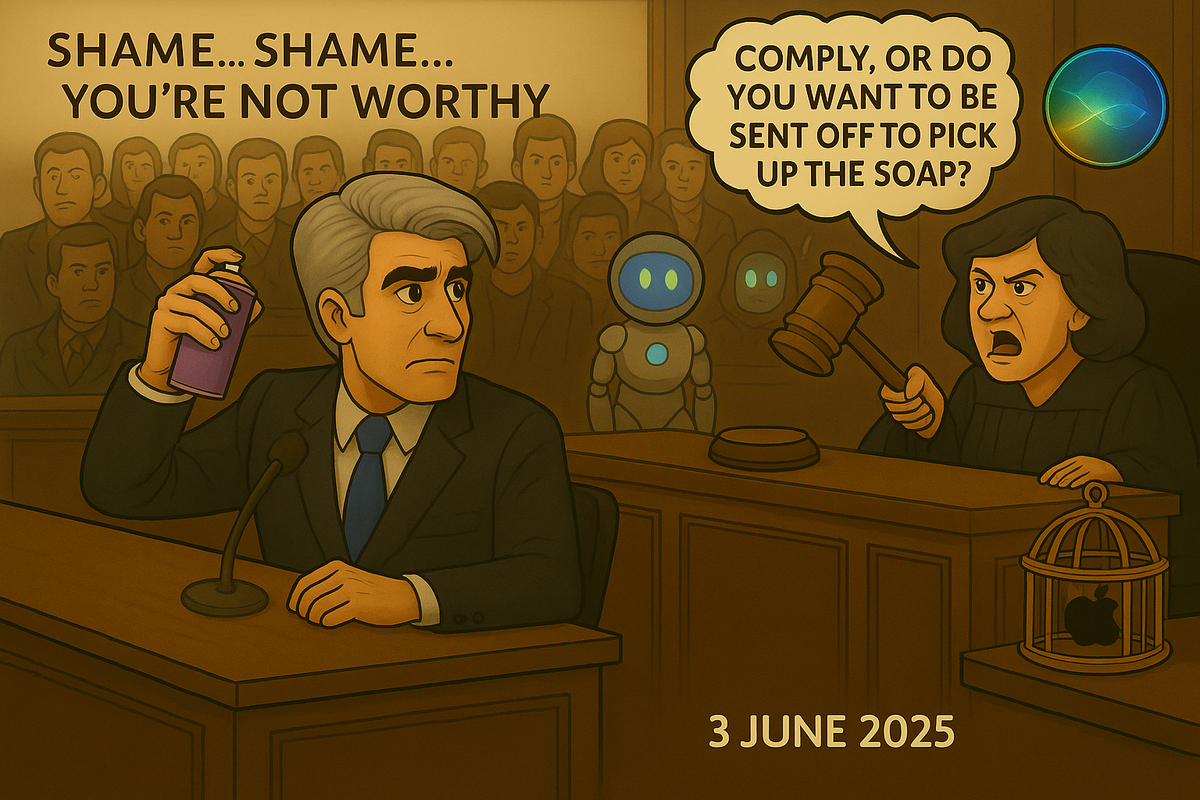
Apple’s ongoing legal shenanigans have been a massive e distraction to the company, and Tim Cook has incurred the wrath of global regulators and routs.
The 30% commission has become harder to justify because it too often looks like a fee charged by the owner of the only door to it - Apple
Apple’s familiar argument around privacy, review, payments, fraud protection, subscriptions and global reach still has substance, but regulators and developers know the weak points by now and in some regions Apple has reluctantly struck a deal, but not yet in its core market - the US.
India’s long-running antitrust case over Apple’s in-app billing and commission structure is one recent example of the pressure surrounding that model, and only this week Apple was forced to make substantial disclosures to Indian regulators in their pursuit of what they’re calling Apple’s ”unfair monopolistic business practices.”
But if Apple can show that it reduces the cost of building software before the customer ever buys it, helps developers reach more platforms, improves safety and compliance, and provides trusted commerce at the end, the fee becomes part of a broader value exchange rather than merely the price of admission - and by allowing developers to reach Android customers too it avoids the charge of being guilty of solely operating the App Store in its own interests and that of its own platform, removing many grounds for regulators actions against it in a single stroke.
The explosive version begins when this stops being only about developers and starts being about Android users.
Apple has done this before.
- iTunes on Windows looked strange to anyone still thinking tribally about the Mac, yet it helped turn the iPod from a beautiful Apple device into a mass-market object that Windows users could justify buying without feeling they had joined a rival religion.
- Steve Jobs launched iTunes for Windows in October 2003, explicitly aiming beyond the Mac’s installed base and toward the 97% of computer users then running Windows.
- Apple placed a piece of its world on enemy territory, made that world useful, and quietly softened resistance.
- Over time, people who might never have bought a Mac or might never have bought an iPod and installed iTunes for Windows, found themselves using Apple software, buying music through Apple, managing an Apple device and discovering that their anti-Apple instincts were less fixed than they assumed.
An App Store for Android could perform the same trick in a larger, richer and more strategic market.
Apple would not aim to replace Google Play but it could begin with categories where trust, payments, subscriptions and family management matter: education, productivity, media, games, health, enterprise software and AI-native tools.
Suddenly there’s no basis for accusations of monopolistic markets controlled by Apple’s App Store:
- Developers using Swift and Xcode could ship iOS and Android versions through Apple’s system, manage subscriptions through App Store Connect, and reach Android users through an Apple-trusted storefront.
- Android users would arrive for a useful app, a better subscription experience, a safer family purchase, a university tool, a workplace requirement or simply a cleaner way to pay. They would not need to switch to Apple. They would simply begin using Apple.
That is the Trojan horse.
Once an Android user has an Apple account, pays for a subscription through Apple, uses Apple’s store, trusts Apple’s review process, perhaps accesses Apple TV, Apple Music, iCloud storage or a productivity app distributed through that channel, the old psychological wall begins to crack. Apple stops being the expensive thing other people buy and becomes a service layer they already use.
The next phone purchase changes shape. So does the next laptop purchase. A future iPhone, or a lighter MacBook Neo-style device, becomes less alien because the user is already partly inside the Apple system.
This is where the idea becomes far larger than an App Store sideloading argument, and enters the realms of exponential market growth for App Store sales and services.
Apple’s growth problem is not simply selling another iPhone to someone already committed to the ecosystem; it is finding credible routes into the habits of people who regard Apple as expensive, closed, unnecessary or faintly hostile to the way they live.
Younger users especially are less loyal to the old ecosystem story, more comfortable with platform-hopping, and less impressed by being told that one brand should contain their whole digital life. I wrote an extensive deep dive on this a year ago with a study of Gen-Z habits.
 Tommo_UK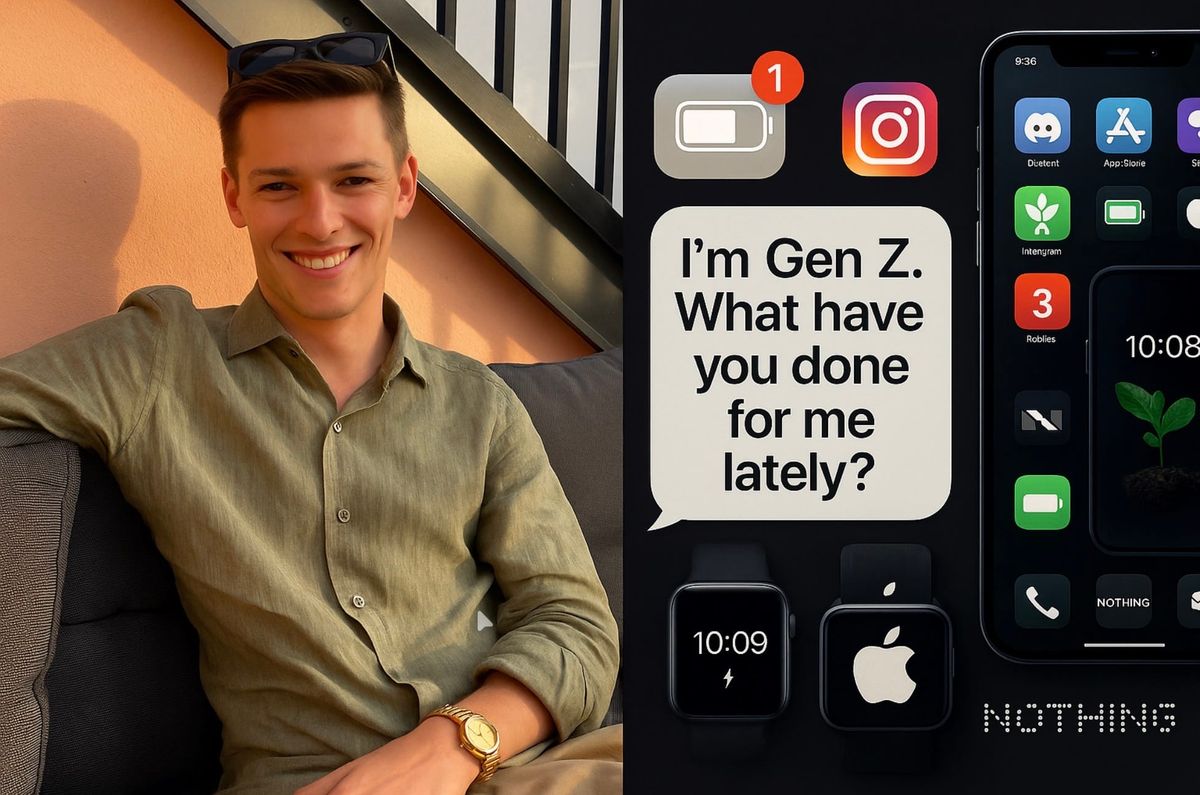
Gen-Z don’t idolise Apple. They like it, but don’t covet it. They’re more likely to say “what have you done for me lately, and why do I have to pay you $129 for a $3 battery change,” than say “thank you” to an Apple Genius Bar member fleecing them for a battery replacement.
The way to reach them may not be another sermon about privacy or another slightly thinner phone. It may be a useful Apple layer that travels to where they already are if they’re not in the Apple ecosystem yet: Android.
For Wall Street, the impact could be a shockwave.
- Services growth would no longer depend only on squeezing more value from Apple’s existing installed base.
- Developer tools would become part of the Services story.
- Android distribution would create a massive new addressable market.
- The App Store’s economics would have a broader justification.
- Apple would gain a path to monetising trust, payments and software distribution beyond the devices it sells directly.
Even modest success would alter the narrative around Apple from defensive enclosure to controlled expansion.
Google would hate it, of course. Regulators would examine every clause but in the end, see it as a sign of Apple opening up to other platforms - which was precisely the calculation Steve Jobs took with iTunes for Windows - which stopped impending legal and regulatory action in their tracks and cemented Apple’s lead in the MP3 player and music download market. He risked outreach, and won. Tim Cook hasn’t had the guts to do that yet, but instead of fighting regulators, perhaps he should try - now that Ternus is taking over - removing the reason for their action and actually bolster the rationale for the App Store’s 30% margin whilst simultaneously addressing the enormous potential of Android App Store sales and other services subscriptions once they have an Apple ID.
Developers would approach it with suspicion but the cost benefits would be simply enormous for them : App Store distribution and access to iOS devices -and free AI token use inside the dev environment. The value proposition and increase in access to the TAM would be irresistible and profound.
Android users would not adopt it out of sentiment but out of pragmatism and a secret satisfaction of being able to have a foot in Apple whilst staying on their Android phones. But we know how this story goes: once you’re half in the Apple ecosystem, you usually end up going all in. It would be a shorter step, for example as student, to transition from a cheap Android phone with access to the Apple App Store and Services, to deciding to make their next laptop a MacBook Neo.
The same logic also applies to developing markets where phones are almost exclusively Android due to costs, and windows PCs are the workhorse.
WWDC would not need to promise the whole thing at once. Apple could emphasise Xcode is becoming a full AI-assisted development environment (which it already is in many ways), that Swift is gaining a more serious path beyond Apple devices and demonstrate Swift producing iOS and Android apps when the compile button was pressed. That local and cloud intelligence will help reduce the cost of building and testing software by an enormous margin, and that App Store Connect will gradually support broader release management.
It could frame this as developer leverage first, cross-platform reach second, and App Store expansion third. The consumer-facing consequence would arrive later, but developers could immediate test and deploy write once, deploy everywhere mobile apps, and not have to pay a per-token fee for their AI-assisted dev costs as many do at the moment outside of the Apple ecosystem/.
Apple’s 30% charge would then sit in a different context.
If Apple offered developers token-free or heavily subsidised AI development: with credible cross-platform release tools, and access to an Android marketplace under Apple’s trusted commercial layer, the App Store fee would look less like a toll and more like payment for a factory, a shopfront, a payment system, a safety layer and a growth channel - with free AI development thrown in.
It would open new markets to developers, give Apple a new Services story, and probably make Dan Ives shriek with sartorial pleasure before finding a way to say $500 with a straight face.
He is already among Apple’s loudest AI bulls, having raised his target to $400 on the view that WWDC could become a major inflection point for Apple’s AI story. Why wouldn’t Apple give their favourite cheer leader with Pom Poms a reason to channel his inner Buzz Lightyear and raise his price target “To Infinity and Beyond!”
A smarter Siri still matters though, as does the architecture to make “Apple” Intelligence (albeit now run by Google) a cross-app and cross device agentic OS, much like my SenseOS speculated a year agin in May 2025.
 Tommo_UK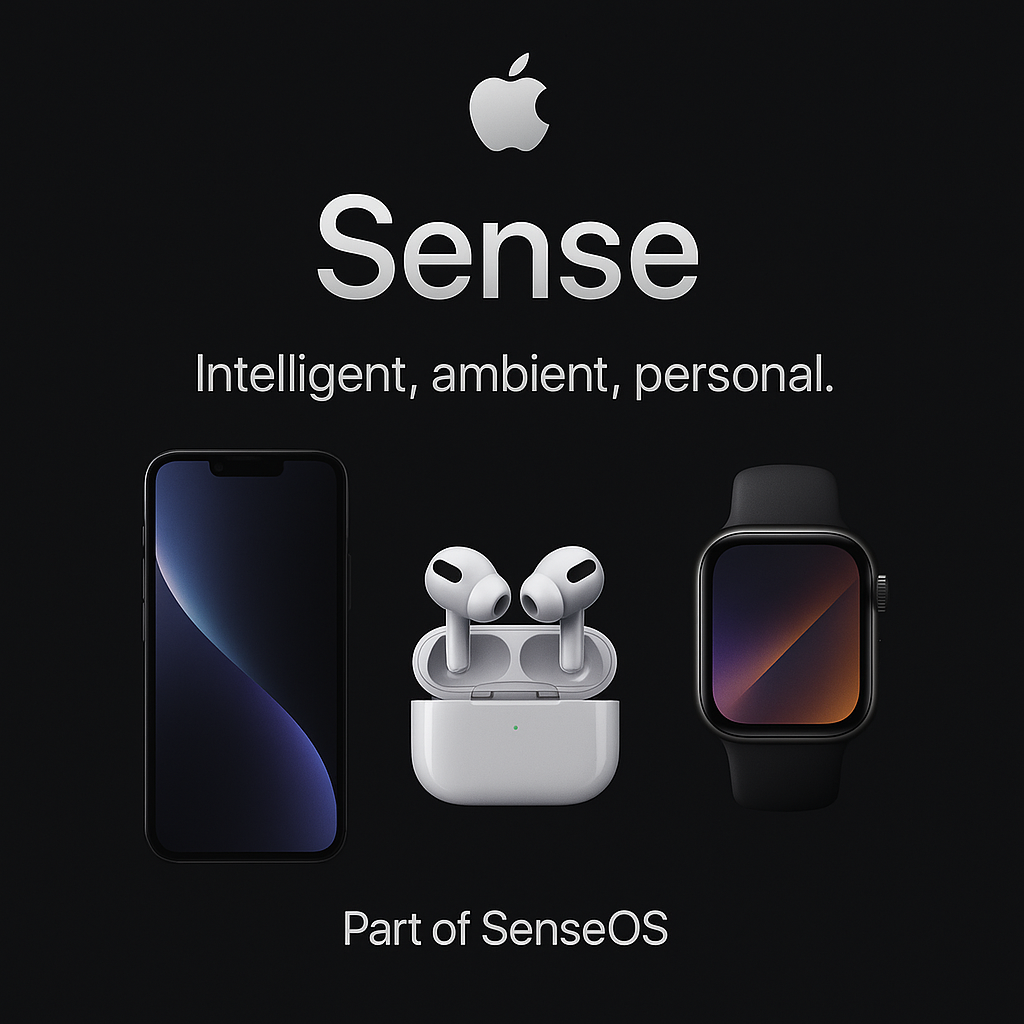
The FYI concept of how an agentic AI OS might work before they existed, and how Apple might have cleaned up a year ago in 2025. In 2026, it seems like this m ight have been a prescient look into the future. Apple’s plans for OS27 seem to be completely aligned with my concept and strategy.
Apple should absolutely fix what has become a reputational wound not to mention a poor deal for consumers who felt so conned into buying iPhone 16s on the back of Apple Intelligence that a class action lawsuit began - which rather quickly, Apple agreed to settle out of court - something reltively unheard of for Apple Legal.
But WWDC 2026 deserves to be all about developers, not consumers, because developers are the ones tasked with delivering the experiences consumers eventually judge. Their costs are rising, their tools are fragmenting, and their AI bills are becoming part of the economics of software before a single user pays a penny.
The One More Thing deserves to be a party for the development community and a unique offer to them:
- build with Swift,
- use Apple’s AI without burning tokens,
- reach Android users through an Apple marketplace, and
- sell through a trusted layer that makes the App Store fee easier to defend because the value is delivered before the transaction, not merely clipped from it after the fact.
It would put a piece of Apple back into the wider world, just as iTunes once did.
That would be a genuine One More Thing, because it would not depend on keynote theatre or nostalgia for old Apple. It wouldn’t need cringe-worthy CGI production which promise the earth and lead to nothing.
It would demonstrate Apple remembering that its most powerful moves were never only about the products it made, but about the markets it taught other people to build around them. Just like Steve Jobs taught the world with iTunes for Windows, which was the Trojan Horse that changed the world forever and opened the door for Apple’s dominance. Tim and John Ternus need to channel their mentor and look back to a genius strategy, to apply it to today’s market, and give Apple, its developers, and its customers n once-in-a-generation. opportunity to expand Apple’s appeal and reach to all platforms while defending its own - by sharing the love of the App Store, and seeing an exponential explosion in App Store sales and services.
And that’s how AAPL could hit $500 for Q4 2027.
With the one caveat: if Hormuz escalates and geopolitics finally starts to eat into the US economy, all bets for the market are off. There won’t be any rate cuts - just as I predicted last year in my article about rates and tariffs in July 2025 - and inflation could soar.
In that event, AAPL will take a bath. But right now:? The market doesn’t seem to care about Iran, or Trump for that matter.
 Tommo_UK
Why Hormuz may yet tip up the US economy and the markets - long read, but a deep dive into geopolitics, and how history has a lesson to teach us.
So what do you think of the idea. Should Apple do this?
What do Android devs reading this think? Sign up for free and add your comments to this thought piece?
Tommo_UK, London, Thursday, 4th June 2026
© 2026 Tommo_UK / tommo.fyi
Follow me on X: www.x.com/tommo_uk
Connect with me on LinkedIn: www.linkedin.com/in/tommo-uk
CONTACTING ME
💡 Reach out to me using the Confidential Drop Box form below.

CONTACT ME DIRECTLY: discreetly (and anonymously if you prefer)