Apple's CEO Tim Cook Loses His Memory, Admits Strategic Error And Yanks Up Prices Anyway.
Tim Cook says Apple’s price rises are unavoidable because memory costs have become a once-in-a-century disaster. But Cook built his legend by seeing supply-chain storms coming. Apple once made bottlenecks serve Cupertino. Now its CEO blames the rain, and AAPL’s premium multiple may notice.

Apple’s problem is being described as memory
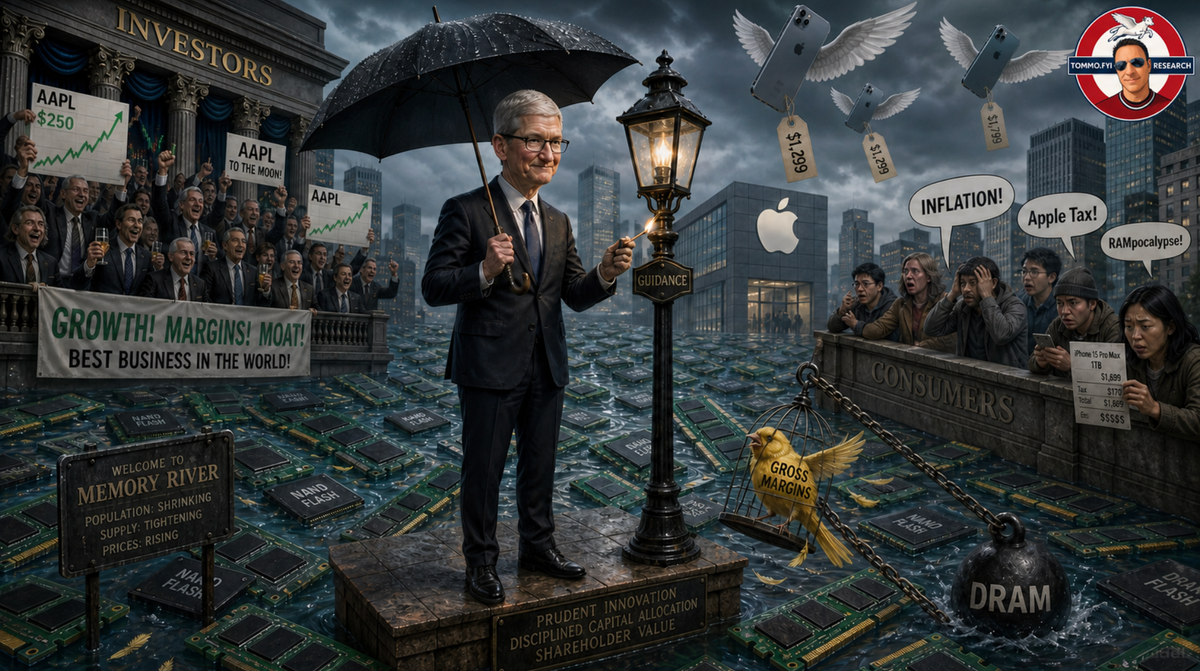
Following the gasp, schlock and theatrical horror at Cook’s recent admission that Apple prices may have to rise, apparently so the company can preserve its handsome margins while customers are invited to participate in the suffering, Apple’s problem is being framed as “memory." In a mid-June 2026 interview with the Wall Street Journal, Cook explained that rising memory and storage costs had become so severe that Apple could no longer absorb them, describing forthcoming price increases as “unavoidable”. Even more theatrically, he characterised the situation as a “once-in-a-century flood”, something he claims never to have seen in over four decades of supply-chain work.
“Unfortunately, price increases are unavoidable.” — Tim Cook, Wall Street Journal interview, June 2026
In one sense, that is true. as DRAM and NAND prices have exploded in line with AI infrastructure devours supply, and Tim Cook now says Apple must raise prices because the situation has become unsustainable. The deeper memory problem, however, may belong to Cook himself: the man who once made supply-chain bottlenecks serve Apple is now describing one as an act of weather.
This is the useful ambiguity at the heart of the story.
- There is memory as component cost.
- There is memory as institutional recall.
And there is memory as investor discipline: the ability to remember what Apple’s premium multiple is supposed to reward. Cook’s flood metaphor touches all three, though perhaps not quite in the way he intended.
A flood that arrives on cue
A once-in-a-hundred-years flood is an act of God, or at least an act of weather. It arrives from the sky, ruins the carpets, fills the cellar, and permits everyone involved to look suitably somber while pointing upwards and shaking their heads in unison at the inevitability of it all. It is a useful phrase because it moves responsibility off the balance sheet and into the Book of Genesis: nobody failed to prepare, nobody misread the map, and nobody spent the previous few years treating supply-chain control as a solved inheritance from a more serious generation of Apple executives. The water simply came, apparently with no warning, and the chief executive is reduced to explaining that nature has turned hostile and we must all just pay the price for his blindness.
But Tim Cook is not Moses, and investors are not being led to the promised land by an anointed mesiah sent by God.
The trouble is that Tim Cook did not become Tim Cook by being surprised by supply-chain weather. There used to be a phrase about Apple: that it makes its own weather. Cook earned his reputation not by standing in the rain, but by buying the high ground, financing the bridges, securing the boats, and letting competitors discover that the dry land had already been quietly leased to Cupertino on terms they should have read more carefully.
Apple once made its own weather. Today, its CEO blames the rain.

If you’d like to read the rest of this article, free of charge but for providing your email, just press the button and select the free tier option. You’ll receive articles direct to your inbox. Don’t worry, you can turn off this feature later, if you don’t want notification.
Note: If you are already a member, but de-subscribed from the newsletter, you will need to re-subscribe to it to access this article. Just go Account settings and re-enable the Newsletter!
How Cook once bent memory to his will
This was never simple procurement. Cook’s old trick was not sleight of hand, but moat-building disguised as purchasing orders. While we usually talk about Apple’s Walled Garden in terms of consumer lock-in, one of its earlier forms was supply-chain lock-in: securing the key bottlenecks before competitors even understood which bridge had been quietly closed.
In the iPod era, Apple did not need to own Toshiba, Samsung, Micron, SK Hynix or TSMC directly.
It needed to be early enough, large enough and aggressive enough to bend the next capacity cycle towards itself. Apple helped finance access, booked supply forward, secured priority and left lesser MP3-player manufacturers discovering that the parts they needed had already been spoken for. When fabs then overbuilt capacity partly in expectation of a wider MP3-player gold rush that never quite materialised, Apple benefited again as prices collapsed: scarcity became a moat, oversupply became margin. Brutal, elegant, and very Cook.
The doctrine was written down in dollars long before it appeared in case studies.
In November 2005, Apple announced long-term supply agreements with Hynix, Intel, Micron, Samsung Electronics and Toshiba, prepaying about $1.25 billion over three months to secure NAND flash memory through 2010. That cash was not a gesture of largesse. It was an instrument: lock in capacity and pricing ahead of competitors, then let the iPod and its descendants sit atop a memory stack wired to favour Cupertino.
Four years later, in 2009, Apple quietly prepaid another $500 million to Toshiba to guarantee future NAND supply, a move noted on Apple’s earnings calls and in Toshiba’s own disclosures. By then, Apple was effectively financing a meaningful slice of global flash output in exchange for priority access and price discipline. Cook’s Apple did not merely participate in the memory market. It helped shape it and was, by proxy, directly in the memory manufacturing business.
Make the bottleneck serve Apple twice: first as scarcity, then as margin.
That was the old Cook doctrine in its purest form: identify the bottleneck, pay in advance, early, to control it, and then let everyone else realise they are crossing your moat, not a public river. It is not just that Apple made its own weather; it built its own watershed and canal system, and nobody else had access.
The arithmetic was there all along
This was not hindsight invented in 2026 because Tim Cook had suddenly found a convenient umbrella marked “global memory crisis.” In the old AFB days when I was a moderator on a then-famous AAPL investor board, we watched NAND, DRAM, LCD panels and hard-drive prices almost obsessively, because they were not decorative inputs. They told us what Apple could build, what it could charge, what it could ship, and what gross margins might look like before Wall Street had finished tying its shoelaces.
Apple’s own filings make the point without needing any nostalgia from me. For 2005, Apple’s reported full-year gross margin was about 29.0%, essentially flat with 2006. The dramatic inflection is really 2006 to 2007, where gross margin jumps from 29.0% to 34.0%, then climbs to the roughly 40% level by 2009-2011.
Fiscal year | Gross margin |
2005 | 29.0% |
2006 | 29.0% |
2007 | 34.0% |
2008 | 34.3% |
2009 | 40.1% |
2010 | 39.4% |
2011 | 40.5% |
Apple’s 2008 10-K gives 2006-2008 directly:
net sales of $19.315bn, $24.006bn and $32.479bn; gross margin of $5.598bn, $8.154bn and $11.145bn; and gross margin percentages of 29.0%, 34.0% and 34.3%. It also explicitly says the 2007 jump from 29.0% to 34.0% was driven partly by “more favorable costs on certain commodity components, including NAND flash memory and DRAM memory.”
Apple’s 2011 10-K gives 2009-2011 directly:
net sales of $42.905bn, $65.225bn and $108.249bn; gross margin of $17.222bn, $25.684bn and $43.818bn; and gross margin percentages of 40.1%, 39.4% and 40.5%. It also says the 2011 increase was largely driven by lower commodity and other product costs including NAND flash memory and DRAM memory.
So just as plunging memory prices boosted Apple’s margins by an extraordinary measure, as I was pointing out to a sceptical Street before the narrative took hold, soaring prices are now likely to hit gross margins unless Apple can push the pain through customers without damaging demand. That is not a weather report but the same arithmetic running backwards.
My record on memory, margins and AAPL
For anyone tempted to treat Tim Cook’s “memory flood” as some unforeseeable act of God, it is worth revisiting what we were all talking about twenty years ago, and how central component pricing already was to Apple’s earnings story. What follows is not nostalgia. It is contemporaneous memory-market evidence from the AFB era using my own historical comments as anchor points: NAND, DRAM, LCDs, hard drives, gross margins, EPS sensitivity, product timing, and the very supply-chain logic Cook is now trying to frame as weather.
A relevant selection of my own comments from that era, twenty years ago, follows:
19 April 2006 — NAND/LCD pricing as margin support
Source: AFB, “The Official AAPL FQ2 Results Topic”
I wrote “Deutsche Bank maintains an upward bias based on the possibility of better-than-expected gross margins. They believe margins will be supported by weak NAND flash and LCD pricing…”
At the time, this was not some obscure semiconductor footnote. Analysts were explicitly pointing to weak NAND flash and LCD pricing as the reason they expected upside on Apple’s gross margin. Memory and display prices were already part of the Apple earnings engine, not background noise.
1 March 2007 — the killer component-cost quote
Source: AFB, “Q2 iPod Sales 12m!”
“NAND prices have fallen by over 60% since Q1 07. DRAM prices have fallen by about 30%. LCD prices by 15%. Hard drive prices by 10%. It is inconceivable to me that Apple cannot improve on its gross margins given these incredible drops.”
That was not arm-waving. NAND had cratered, DRAM and LCD were following, and I was explicitly connecting multi-component deflation to Apple’s ability to expand gross margins. If your biggest volatile inputs get dramatically cheaper, you do not need a séance to divine that future margins and EPS should improve.
23 April 2007 — the margin story “has legs”
Source: AFB, “Wednesday: All Hands On Deck!”
“I think the margins story has a few legs left.. DRAM prices continue to plunge, and NAND prices have gone nowhere, so they’re still under half what they were just a few months ago, leaving AAPL room to double capacities without threatening margins at all.”
This was the more important nuance. Component deflation did not merely protect margins; it gave Apple room to improve the product. Larger capacities, better configurations, richer iPods — without frightening the earnings model.
Fast-forward to 2026 and Cook is claiming the inverse: richer memory and storage configurations now require price increases because the component-cost leverage has turned against Apple. But somehow as if by magic, higher prices will not impact sales, and higher costs won’t impact margins.
25 April 2007 — every margin point mattered to EPS
Source: AFB, “Analysts’ Commentary: Q2 and beyond”
“Every point of gross margins lower than 34% knocks off 5c from my forecast…”
And then, given what we knew about components:
“With component costs having fallen between 15-50% though, I cannot see how the company can fail to achieve GM of 34% unless there’s been some significant rise in costs elsewhere than I’ve just totally overlooked.”
That was discipline: not just saying components mattered, but modelling the effect point by point. If falling memory prices had a measurable positive impact on EPS, the symmetric conclusion is now unavoidable. Rising memory prices will have a measurable negative impact unless prices rise, margins compress, or both. Today’s “unavoidable” price hikes are the other side of the trade I was describing in 2007.
13 June 2007 — JPMorgan vs reality on NAND
Source: AFB, “Q3 Margins Surprise”
“NAND prices ARE NOT firming, they are WEAKENING.”
Underneath that, I quoted an analyst note:
“…the big gross margin boost the company received in the March quarter from a steep drop in flash memory pricing…”
Even then, the Street understood that flash memory pricing had given Apple a “big gross margin boost.”
It just kept misreading direction and duration. If analysts were slow to see component deflation as an earnings tailwind, it is hardly shocking that analysts now under-model component inflation as an earnings headwind. But the symmetry is there. You cannot treat falling NAND as a margin boost in 2007 and rising DRAM as a mere weather observation in 2026.
28 August 2006 — NAND checks as product-roadmap evidence
Source: AFB, “New iPods: When?”
“Checks of the NAND flash market apparently indicate a launch for a new 8GB nano in October.”
That small line captures the old culture around Apple analysis. If you wanted to understand the product roadmap, you watched the component trail. NAND was not an afterthought. It was a clue.
- Taken together, these AFB posts show that as early as 2006-2007 I was explicitly modelling Apple’s earnings and margins as a function of component pricing, with memory as the largest and most volatile input.
- Back then, I argued that memory deflation would be a margin and EPS tailwind, and it was. Today, investors who refuse to model the symmetric headwind of memory inflation are choosing comfort over arithmetic.
Cook’s “once-in-a-century flood” language makes that choice feel respectable. The record suggests it is anything but.
Fast forward almost twenty years. The 2026 AI memory crunch is real — and convenient
Fast-forward to 2026 and the bottleneck is memory again. This time, however, Apple is not the company making the bottleneck serve its strategy. DRAM and NAND prices have, in fairness, erupted. High-bandwidth memory for AI accelerators is devouring wafer capacity; TrendForce and others report contract DRAM pricing surging sharply, with NAND flash prices climbing in parallel as hyperscalers redirect supply into data-centre SSDs. What used to be a cyclical, slightly dull components market has become a structurally tight industry, dominated by AI demand rather than handset launches.
In that narrow sense, Cook is not inventing the problem. Memory prices really have soared; supply is being skewed towards AI servers; consumer DRAM and storage are being asked to live with the scraps. A “once-in-a-century flood” shock is, in the language of pricing charts, not entirely dishonest.
But metaphors are not neutral. A flood, rather than a market dislocation, is a way of saying: this happened to us, not through us. It shifts the story from “we failed to secure the moat the way we used to” to “the river breached the banks.”
The strongest defence of Cook is also the most revealing one.
In 2005, Apple could shape a consumer electronics memory cycle because its own demand was decisive. In 2026, the bottleneck serves AI infrastructure first. Nvidia, Microsoft, Google, Amazon and the broader hyperscaler swarm now sit at the head of the table. Apple may still be rich, enormous and powerful, but it is no longer obviously the marginal customer setting the terms. That is not a rebuttal to this article. That is the article.
The issue is not that Cook should simply have repeated 2005 with a bigger cheque. The issue is that Apple has moved from price-shaper psychology to price-taker language, and Cook’s metaphor gives the game away. A company whose product cycles require long-lead component ordering, supplier visibility, prepayments, capacity reservations and multi-year manufacturing choreography does not get to wake up in June 2026 and discover that AI data centres have been eating memory. Nvidia did not creep into the supply chain wearing a false moustache.
The memory shock is real. Cook’s innocence and faux-surprise is not.
From supply-chain mastery to soft gaslighting
When the CEO of an (almost) four-trillion-dollar company tells hundreds of millions of customers and a global investor base that price increases are unavoidable because of a centennial memory flood, he is not merely reporting the weather. He is attempting to curateconsent with a “namaste” prayer and a head tip. “Gaslighting” is an ugly word, overused enough to require its own recycling bin in my opinion, but the glass slipper fits here if we define it precisely: Cook is reframing an execution and positioning problem as an exogenous shock, then inviting Apple buyers and AAPL holders to accept that reality as pre-destined.
The theatre is familiar.
First, emphasise how long you have heroically absorbed the pain on behalf of customers (Apple hasn’t done anything of the kind; it has reduced manufacturing costs, and increased margins on services, to ensure some hardware has seemed price-static – the reality is Apple has ensured you’re paying, one way or another, for your Total Cost of Ownership of living in the “Apple Supply Chain” of consumer-sales profits. In the Journal interview, Cook stressed that Apple had “been striving to shield our customers” from surging memory and storage costs, but that the situation had become unsustainable.
Then elevate the moment to historical anomaly: a once-in-a-century flood unlike anything seen in forty years of electronics supply chains. Finally, hint at noble restraint: Apple will look at every option, may even use its cash reserves to help increase capacity, but will not build its own DRAM fabs or enter suicidal bidding wars with AI hyperscalers.
Oh come on, doesn’t anyone else apart from me not see this for the misdirection it really is? Gaslighting.
The narrative is arranged to make Apple sound both victim and responsible adult:
- Victim, because forces “beyond its control” are punishing its 50% margins which shareholders now expect – bugger consumers.
- Responsible, because it allegedly shielded customers for as long as possible and will continue exploring remedies — provided those remedies do not require Apple to admit that it misjudged the cycle, under-committed to the bottleneck, or lost the old memory of how it once engineered these crunches to its competitors’ disadvantage.
At no point does the story linger on the awkward continuity. The company that once prepaid billions to help build out and lock up flash supply now explains, without irony, that it has been caught short by a memory market it cannot bend any more – because Apple is no longer ahead of the curve.
- The CEO celebrated for seeing bottlenecks coming, and then profiting from them, now tells us this particular bottleneck is an act of weather.
- The investor base that grew comfortable treating AAPL as a synthetic bond — a margin machine cross-subsidised by services, storage upsells and buybacks — is asked to accept that the bond will simply pay less unless customers agree to make up the difference at the till.
When a company that once controlled the weather starts calling the flood an act of God, it isn’t being honest. It’s being convenient.
Margins, options and the real audience
Strip away the flood imagery and the incentives are straightforward. Apple has spent years tuning its business into a high-margin, cash-rich machine that investors treat, at anything near 35-40x earnings, as a bond proxy with optionality.
A sudden, uncontrollable spike in memory and other component costs threatens that equilibrium. Either margins compress, or prices rise.
For a management team deeply invested in defending the aura of inevitability around Apple’s earnings story, only one of those options is truly comfortable in defence of a share price about 25% ahead of itself at 35x given its earnings growth is a tepid 11-12%
Cook’s interview reads in that light less like a lament and more like a conditioning exercise. The audience is not just the family discovering that next year’s iPhone, Mac or iPad costs noticeably more. It is the analysts and portfolio managers who need a ready-made sentence to explain why gross margins will not fall in line with component inflation. “Unavoidable price increases due to a once-in-a-century memory shock” is a more comfortable line on an earnings call than “we under-invested in the bottleneck and are now caught in the queue.”
The Dan Ives of this world come out the same day screaming the inevitability of $400 any year now, and forum investors talking about a 45x multiple being “totally reasonable” tells you all you need to know about how the reality distortion field is pulsing over the market but eventually, people will see through this, and gravity is likely to re-assert itself viciously,
 Tommo_UK
Dan Ives - Never Knowingly Out-Priced
My old AFB modelling discipline matters here because it stops the current debate floating away into metaphor.
Component costs were never abstract. They dropped straight into gross margins, and gross margins dropped straight into EPS. In April 2007, after modelling Apple’s Q2, I wrote that “every point of gross margins lower than 34% knocks off 5c from my forecast.” One point of margin was not a rounding error. It was earnings. It was the beat, the whisper number, the analyst note, the after-hours move, the multiple investors were prepared to award.
The same logic runs in reverse today.
Falling component costs gave Apple room to beat. Rising component costs now threaten the quality of those beats unless the customer is made to absorb the difference. That is what makes the present situation dangerous for AAPL. The issue is not whether Apple remains profitable. Of course it does. The issue is whether investors continue treating those profits as premium, controlled, high-quality and multiply expandable, or begin treating them as more exposed to commodity pressure, pricing exhaustion and strategic delay than the 35x story admits.
The flood is not just a story about chips. It’s a story about who gets paid first when reality turns up.
A long memory and a short accountability
For those of us who have watched Cook for twenty-five years, this moment is hardly an isolated slip but sits within a longer, rather depressing pattern in which Apple has become progressively more comfortable externalising the consequences of its own strategic hesitations and focused on financial execution and not products. those new lines dreamt up by Cook have either been cancelled before birth or flopped because of poor product planning and ultimately n0 use case.
The company that once made bold, painful bets on supply — prepaying for flash, locking in long-term silicon, taking risk onto its own balance sheet — now prefers to sit on a vast cash pile and talk about constraints as if they were acts of nature, and can’t think of anything better to do with its cash than buy back its own stock. Which in some ways, has a certain adjascent-ness to a teenager with too much time on his hands but not enough imagination, failing to do his homework and instead watching P*rnhub with the remote in one hand and, well I’ll leave that allegory with you.
The memory crunch could have been anticipated.
AI infrastructure has visibly devoured DRAM and NAND for years and as one of its biggest consumers, Apple would and should have been more than aware of the crunch coming, wel before anyone else noticed it. I raised the prospect of this crunch in December 2025, when I wrote here that Apple's forward-supply contracts ran out in summer 2026, at which point it would likely experience a shock in component prices hitting it, and the question would be would it pass these on to consumers or absorb some of them into its huge gross margins of ~50%. We have the answer now. It's passing it on, and assuming there will be no impact on sales, and investors are so far, following the pied piper as if higher prices were a good thing, because they somehow elevated Apple into a pmore premium position as a vendor to the rich and well heeled.
Hyperscalers began telegraphing enormous capital-expenditure budgets in 2024 and 2025.
Memory-market research houses have been publishing increasingly panicked charts about “RAMageddon” and the repricing of high-bandwidth memory since at least early 2025. Apple is close enough to that market, with its own data-centre ambitions and embarrassing enough reliance on rented infrastructure, not to claim innocent astonishment. Apple is hardly out of the loop on these movements, being deeply embedded in the supply chain itself and in datacentres too.
A CEO with Cook’s history cannot plausibly claim to have been taken unawares.
He can only imply, very gently, that Apple chose not to expose itself to the same level of aggressive, early commitment that once defined its flash strategy. In narrow corporate-finance terms, that may even be defensible. Why race hyperscalers into multi-year, multi-billion-dollar memory contracts when you can raise prices on consumers and let the brand carry the load?
But it is not a biblical flood at all. Apple's predicament and the cost now about to be borne by its customers, stems from a decision to prioritise margin protection and narrative continuity over the forward-leaning supply-chain aggression that once made Apple the company others feared to cross.
The old Apple did not merely survive the siege. It made sure everyone else ran out of supplies first. RIP MP3 market, except for Apple.
If this is a once-in-a-century flood, it’s one Apple’s Tim Cook walked into with his eyes wide open and just didn’t look at the landscape.
The multiple is the real floodplain
This is where the equity story becomes more dangerous than the product story. Apple can continue printing money and still lose a quarter of its market value if the market decides the money deserves a lower multiple. This is the bit of AAPL arithmetic the comfort merchants tend to skip because it ruins the scented candle atmosphere. A stock at 35x earnings does not need an earnings collapse to fall sharply. It only needs the market to stop believing that those earnings deserve 35x.
 Tommo_UK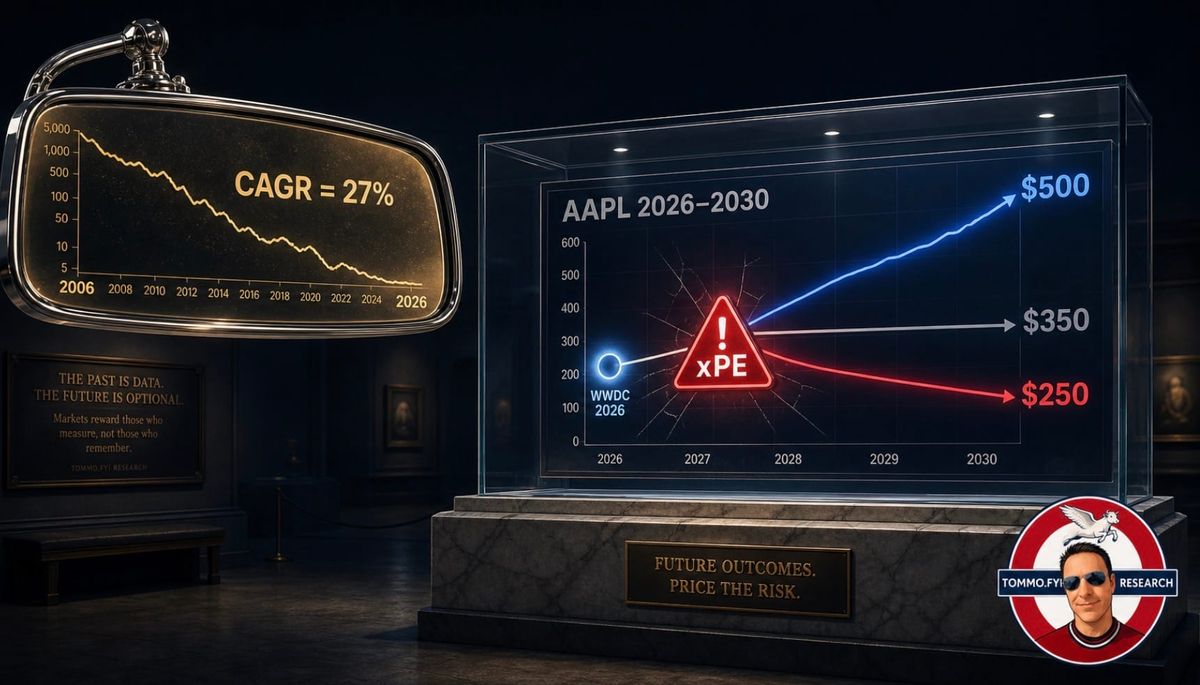
Why Looking Forward Not Backwards, Matters
At $300, a 35x multiple implies roughly $8.57 of forward earnings power. Keep the earnings exactly the same — no collapse, no disaster, no bear fantasy involving tumbleweed outside an Apple Store — and re-rate that same $8.57 to 28x. At that point the share price is no longer $300. It is about $240. Push the market’s mood a little colder, or allow for a modest EPS trim from memory costs, weaker buybacks, slower upgrades or thinner gross-margin protection, and suddenly $225 is not apocalypse theatre. It is spreadsheet gravity and shows that even with Apple performing and generating free cash flow like a monster, that doesn’t necessarily equate to “AAPL ever upwards” any more.
That is the real audience for Cook’s flood story. Not just the customer being prepared for a more expensive device. The investor is being prepared too. “Once-in-a-century memory shock” is not merely a pricing explanation. It is a multiple-defence phrase. It says: do not punish us for this; do not treat this as execution failure; do not compress the premium; do not notice that the old supply-chain weapon is now a weather excuse.
But that is precisely what a rational market should examine.
If Apple’s premium multiple is partly built on operational control, supply-chain mastery, pricing discipline, buyback reliability and the belief that management sees around corners, then a visible memory bottleneck arriving just as Apple needs more memory for its AI cycle is not a passing input-cost inconvenience. It is a challenge to the story that made the multiple possible.
This is not the 2005-2007 Apple that was still under-earning its future and trading at a valuation base of a 12x multiple that presumed failure every year, because it was viewed, as “the iPod company” as just one release away from being a flop.
Back then, component tailwinds, iPod dominance, Mac halo and iPhone optionality were all under-modelled. Today though and in stark contrast, Apple is priced as if resilience itself is a product line. That is a very comfortable place to sit while listening to the soothing sounds of Wedbush, Evercore, BoA and all of the other analysts talking up their books.
But when the market wakes up and asks whether resilience includes being surprised by the same kind of bottleneck Tim Cook once made famous by controlling, there could be a multiple re-rating, and not in the direction Gene Munster was anticipating pre-WWDC 2026.
The old AAPL lesson was simple: gross margins move EPS, EPS moves narrative, narrative moves the multiple.
In 2007, falling NAND, DRAM, LCD and hard-drive costs helped Apple beat the model. In 2026, rising memory costs threaten to expose how much of the model depends on Apple being able to pass pain through the customer without slowing the machine.
That is a much less cheerful version of pricing power and the mesage is less “Apple customers will pay,” and more like “Apple customers had better pay, or the multiple starts looking overdressed.”
Why Apple can stay great, but AAPL may just iterate
Apple does not need earnings to collapse for the stock to fall. It only needs the market to decide that the earnings are less controlled, less strategic and less deserving of a premium multiple than Cook’s old reputation suggested.
For anyone who does not want to soothe themselves with the comforting words of Asymco’s Horace Dediu, who brushed off this awkward little development as a net benefit because Apple could charge more in price uplifts than the actual component increase would cost it, I have a bridge to sell you. If that does not land, let me make it plainer.
Horace’s neat relative-damage argument last week — that rising memory costs hurt cheaper Android vendors more than Apple because a $100 or $140 component shock is easier to hide inside a $1,200 iPhone than a $300 handset — is not wholly wrong, it’s just answering the wrong question.
Pardon me, but this is hooch and with respect, Horace is being a nincompoop. Apple is not valued as the company that merely suffers less than budget Android vendors. It is valued as the company that controls the stack, controls the supply chain, controls the margin bridge, controls the customer relationship and controls the narrative.
“Worse for everyone else” may be a relative competitive argument. It is not a 35x multiple argument.
Apple has more room to pass through cost. Fine. But that settles only the unit-share comparison, not the valuation question and it's the valuation question which makes or breaks AAPL going forward. A company yet to prove it can return to delivering 15% earnings growth or 20% let alone the anaemic 11-12% of late, has few arguments to be rewarded with a 35-40x multiple just because Siri can turn the lights off in two room of my house in one command, and isn't out of beta yet.
If all hope hinges on Siri and a dubious iPhone Ultra Fold for a boost in earnings growth from 12% to 25% to justify that multiple, then investors may be in for a wait.
I was still giving Apple the benefit of the doubt in late 2024, arguing in comments on the venerable Apple 3.0 blog that Apple’s architecture might leave it with “no supply constraints and little additional capex to worry about” while others spent billions on Nvidia hardware. That was the generous case I painted, and it depended on Apple actually owning the AI stack and exploiting its silicon advantage.
What happened instead was less flattering: Apple delayed, rented, gated features behind RAM, and now faces memory inflation precisely as its AI cycle needs more of it.
That is the distinction the CAGR comfort crew keeps missing.
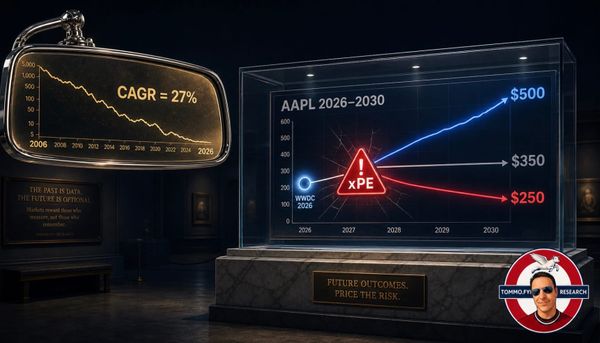
Apple’s historical compounding was real. The question is whether the mechanism that created it still exists. Past performance is evidence, not destiny. AAPL can remain a magnificent company and still become a less magnificent multiple.
Tim Cook’s final weather report
Tim Cook will shortly hand formal leadership to John Ternus, but his fingerprints will remain all over Apple for years as executive chairman. The memory-flood narrative is therefore more than a passing remark in an otherwise routine interview. This is the final weather report from a CEO who built his legend on mastering storms and now stands in the doorway explaining that the rain was unforeseeable.
In that sense, this piece is not really about DRAM or NAND memory prices at all. It is about memory in a different register:
- the industry’s memory of how Apple once behaved;
- investors’ memory of what they thought they were buying;
- and Cook’s apparent hope that history can be gently rewritten as an unfortunate act of nature rather than as the consequence of his decisions, omissions and preferences.
Apple used to make its own weather. Cook now wants us to believe the forecast was handed down from the heavens. That in itself is a cautionary tale against the religious insistence that Apple is still such an example of exceptionalism, that it can trade on hope and n0t on what it has failed to ship yet.
Tim Cook has been, in many respects, a remarkable steward of Apple’s balance sheet.
He turned a hardware success story into one of the most profitable machines in corporate history, wrapped in buybacks, dividends and a services narrative so comforting it can be recited in one breath on CNBC.
AAPL hit $260 in December 2024 on AI hopium, only to fall to $167 in April 2025. Since WWDC 2026 on 8th June 2026, the stock has gyrated link a whilrling dervish between $290 to $317 as traders jumped in with both feet on command by Ives et al, and invesstors held firm gritting their teeth in a zealot-like insistence that the AI and Siri they dismissed as unimportant when Apple couldn't make it work for 16 years, suddenly mattered enough now to pin hopes of a 40x multiple on.
 Tommo_UK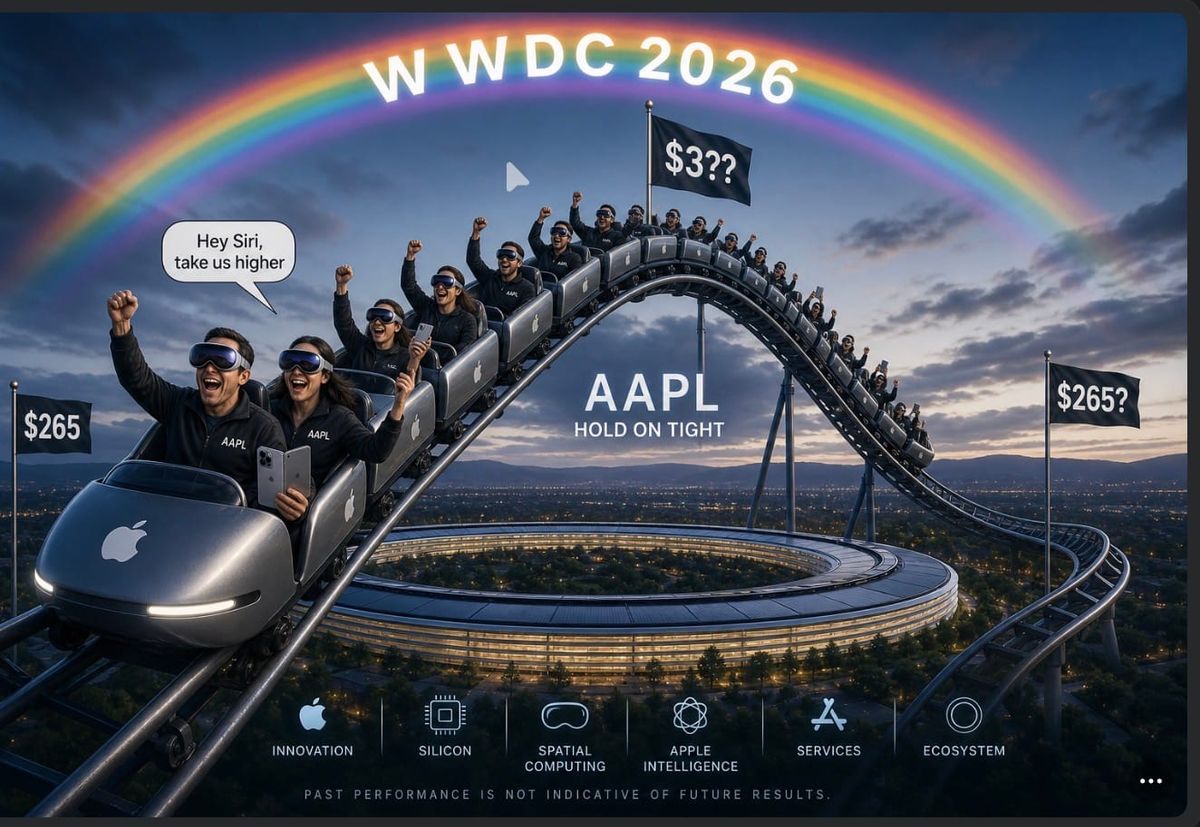
My prediction pre-WWDC of a rally up to and over WWDC of >$300 and a dip afterwards. Today, 25th June 2026 two weeks later, AAPL plunged 5% in a day to $276
Now In 2026, with a compressed multiple, AAPL could be “fairly priced” anywhere from $225 to $275 without being cheap, because valuation is a subjective term, and in the end, a company growing earnings at 11-12% with rising costs and a truncated buyback programme, can only defy gravity for so long.
I wrote from October 2025 through to pre- and post- WWDC 2026 in June this year, that investors needed to ask themselves hard questions. Is the iPhone Ultra going to be a big revenue earner? Can the multiple be sustained? What will Apple’s AI delays cost it? Would the supply chain lead to higher costs? What is Apple’s future product release roadmap looking like, and most importantly,what does it have to ship, to begin to deliver the confidence in it’s competence again?s competence again?
 Tommo_UK
Why Apple's Product Roadmap May Not Be AAPL's
My thesis, written in this article below, was that Apple’s next great product has to be its own culture, not new hardware. John Ternus is showing signs of recognising this from some recent comments attributed to him, but to quote his mentor Steve Jobs before him, “Great Artists Ship,” and until Apple ship something more than betas and delays, it still isn’t getting my benefit of the doubt. I argued last year and this year, that AAPL at $300 is too fast too early and too vulnerable. If you’re in it, no point in selling, but if you’re trying to make a quick buck off Dan Ives and chums (and AAPL is back to being a heavily traded stock again), then you may very well lose your shirt.
 Tommo_UK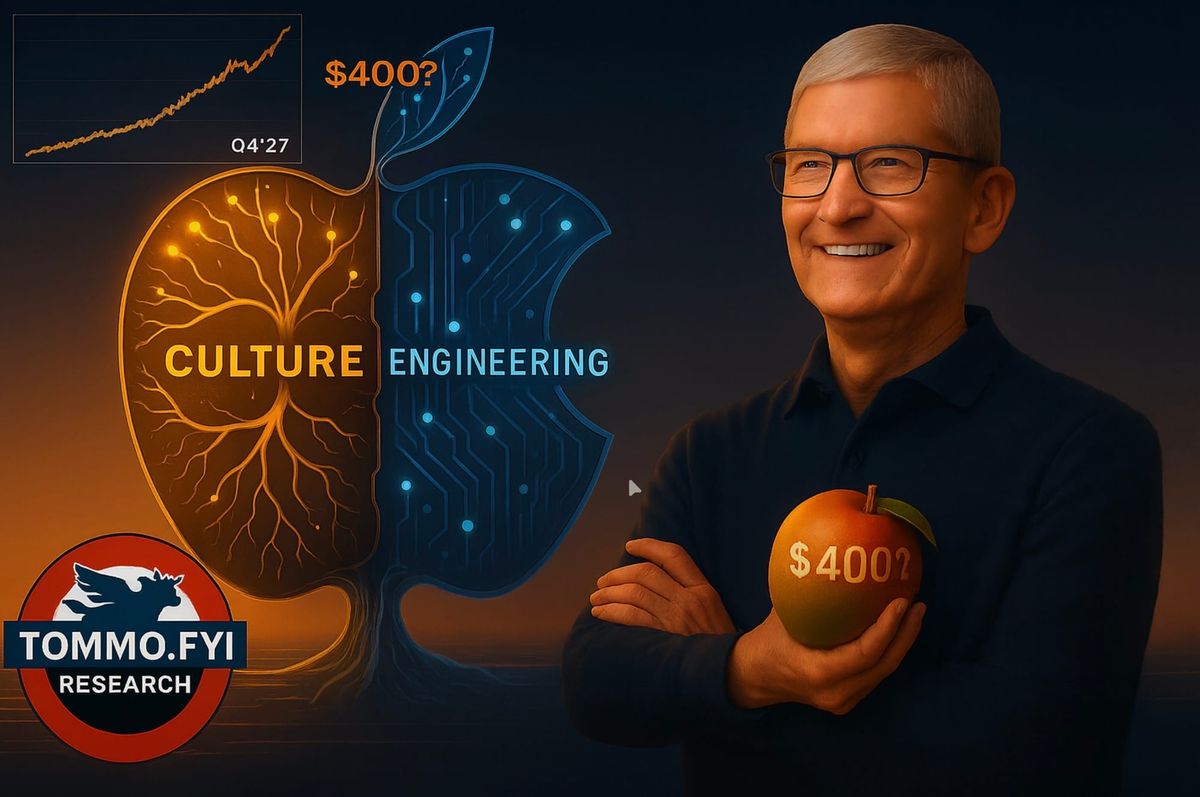
Why Apple's Next Product Needs To Be Culture, Not Hardware
But back to memory before I forget: this centennial-flood line will stand as a revealing epitaph.
This is the moment when a man who once bent bottlenecks to his will, tried to convince the world that he was simply caught in the rain, and that the only responsible response was to charge everyone more for umbrellas.
The rest of us are under no obligation to bring one for him, and while Apple will inevitably try to test price rise tolerances to navigate what it can get away with, talks of supercycles must be now listeneded to with caution. There's always a lot of talk about the size of Apple's used iPhone market. This year and next, in the middle of a cost of living crisis, we may see the pre-sold marketplace become a prime source of sales for cash-strapped consumers - especially and crucially Gen-Z - who won't want to pay a tax on top of what they see as an Apple Tax of high sticker price, in the form of price inflation. Wages have not kept pace with inflation, and with this latest push, Apple may be stretching the envelope too far in its efforts to milk customers of every last dollar to maintain their extraordinary margins.
It seems that over the last twenty years after mastering the memory supply chain and profiting from it, Tim Cook may now have a rather serious memory problem, recalling his own past strategy to manage component crises: own the chain, don’t rent it.
Fortunately, I never forget, and I’m happy to fill in the gaps, to remind him that he’s accountable, and should be ashamed of himself, for contending he was dealt an invisible blow by the DRAM crisis. In the pas he anticipated and weaponised memory problems. In 2026, Cook seems to have forgotten how to get ahead of the trend.
Update, 25th at the open June:
I began writing this article on June 19th after Cook’s initial comments and had to take my time to research my own remarks from 20 years ago. Maybe Cook should have similarly re-examined how he controlled the supply chain in the past - especially NAND and DRAM. Apple has today announced significant price increases on Macs and iPads, and AAPL fell 7% at the open. That market reaction is precisely the point of this piece:
the question is not whether memory costs are real, but whether Apple’s premium multiple can keep treating them as weather rather than execution risk.
Tommo_UK, London, Monday, 8th June 2026
© 2026 Tommo_UK / tommo.fyi
Follow me on X:
www.x.com/tommo_uk
Connect with me on LinkedIn:
www.linkedin.com/in/tommo-uk
CONTACTING ME
💡 Reach out to me using the Confidential Drop Box form below.

CONTACT ME DIRECTLY: discreetly (and anonymously if you prefer)
Further reading and source spine
“Apple, Horace Dediu, And The Twenty-Year AAPL CAGR Ploy”
https://www.tommo.fyi/apple-horace-dediu-and-the-twenty-year-aapl-cagr-ploy/
Best for the backward-CAGR / multiple / buyback critique:
“AAPL Q3 Preview: $160, Mediocrity, or $400?”
Best for the $160/$400 framework and Wall Street not modelling uncomfortable paths:
“Apple - Post-WWDC: Siri AI Looks Like the Future. Its Rollout Looks Like A Big Problem.”
Best for the 12GB RAM / AI-gated hardware / customer-cost angle.
“Apple 2026: How Did Apple Turn Into Microsoft?”
Best for institutional decay and the prior RAM/NAND pricing warning.
“Apple’s Journey from 2024 to 2026 Looms Large with WWDC Ahead”
Best for the cash/buybacks/memory/chips/supply-chain resilience quote.
“Apple’s $3000 Foldable Fallacy”
https://www.tommo.fyi/apples-3000-foldable-fallacy-has-tim-cook-forgotten-how-to-just-say-no/
Best for “historic domination of the supply chain was a strategic weapon” and TSMC no longer treating Apple as “first amongst equals.”
Apple 3.0, “Why Apple will be OK, post Buenos Aires”