Apple Silicon’s Advantage Just Got Severed. By Nvidia.
Apple proved integrated ARM computing and mobile was the future. Nvidia just agreed, bringing Microsoft, CUDA and the PC industry with it. Apple Silicon remains superb, but no longer mystical. If RTX Spark works, Cupertino’s private motorway lane now has competition running up against Apple’s bumper

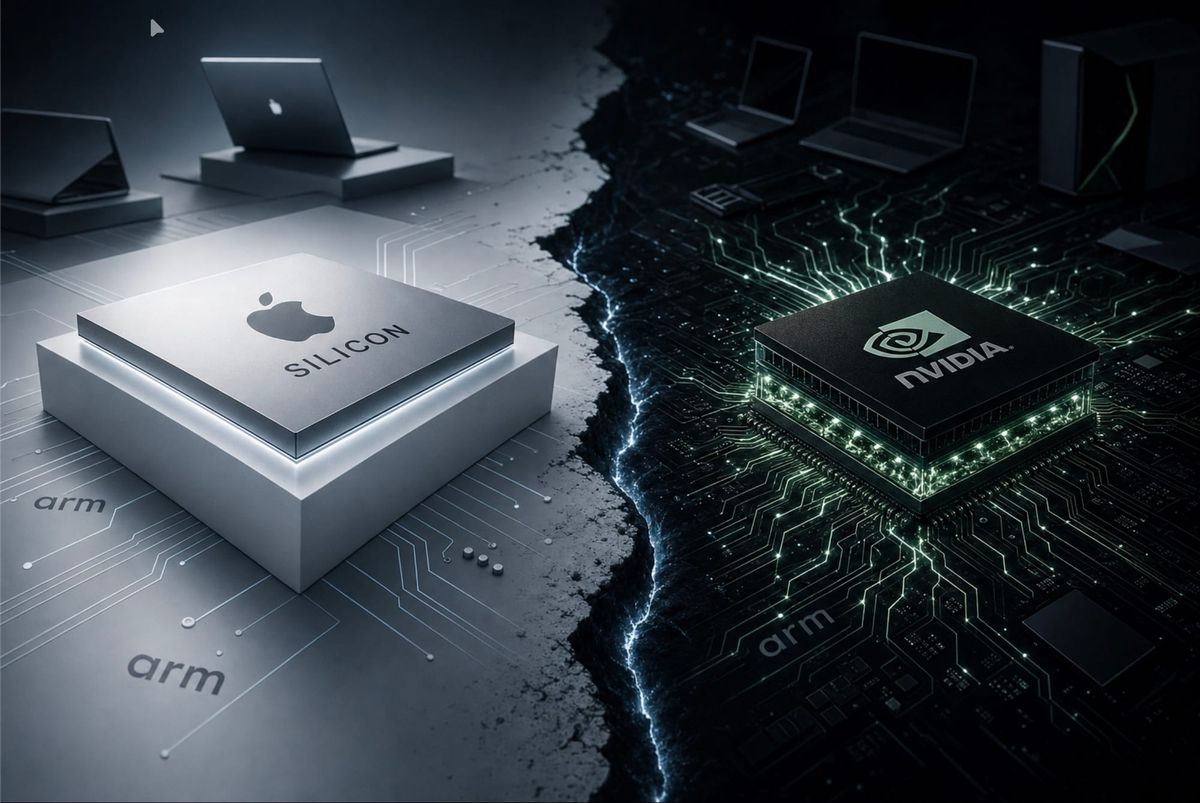
If you’re wondering why NVDIA is up 5% today and AAPL down 2%? If I were an AAPL holder, I wouldn’t be dumping AAPL but I’d be spreading my allocation by selling some, and buying NVDIA too.
Last week I wrote about the narrowing moat of Apple’s Silicon “exceptionalism.”
 Tommo_UK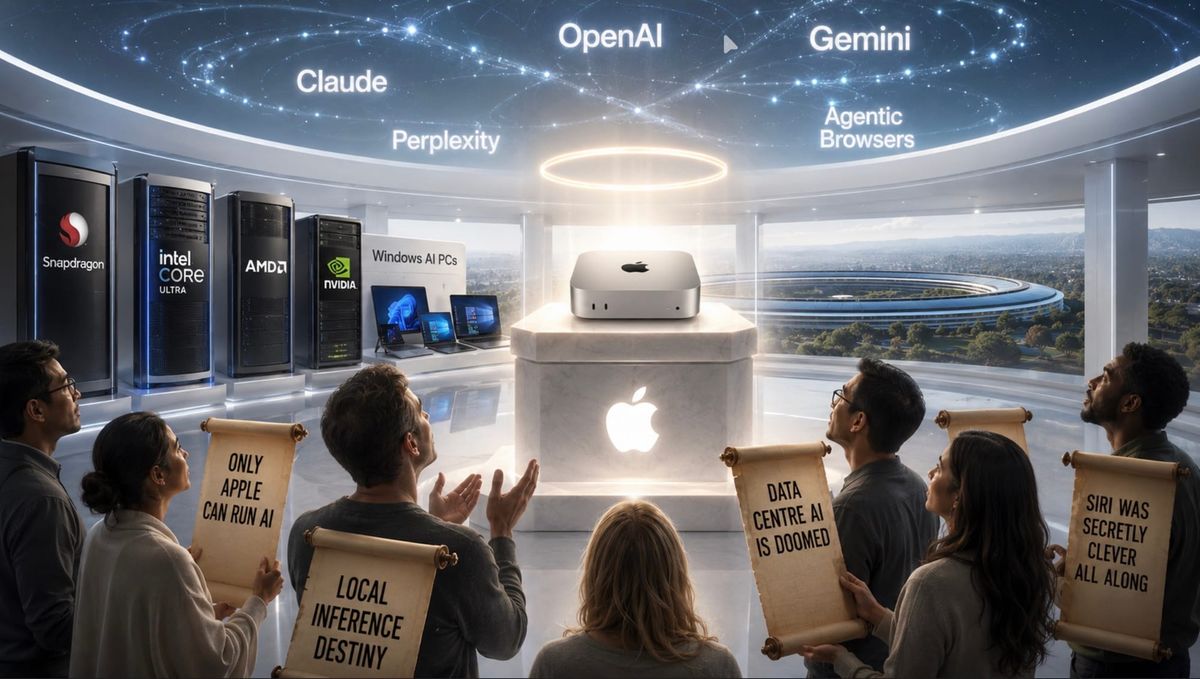
Last week, under embargo about the NVIDIA news, I wrote a piece about Apple Silicon, and why it was no longer enough to stay ahead. Some people scoffed.
I wrote that article as a heads-up because I knew there was a breaking story due from NVIDIA which I’d promised not to discuss.
I did however, want to flag the risk to Apple, because its Silicon is no longer the exception, nor is its ARM and RISC architecture any more.
NVIDIA and Microsoft have been working on similar integration between OS and CPU for 3 years, and the project is finally in the public domain.
The Guardian reports Nvidia’s RTX Spark combines processor and graphics capability, has been developed with MediaTek, and is aimed at putting advanced AI directly into laptops and desktops rather than leaving everything dependent on cloud computing.
The Verge reports flagship configurations with up to 20 CPU cores, 6,144 GPU cores and up to 128GB of unified memory, with Microsoft, Dell, HP, Asus, Lenovo and MSI among the hardware partners preparing machines.
That starts to look uncomfortably familiar. ARM. Unified memory. AI acceleration. Tight OS cooperation. Local model execution. A platform story, rather than a component story.
This changes everything.
While NVIDIA’s initial chipset (which runs Windows x86 apps under emulation, much like Apple did with Intel apps on Apple Silicon) is aimed at high end laptops and desktops initially, it is the start of a family of silicon it will launch, which will include mobile and lower end devices. The architecture shares much with Apple’s Silicon with memory and neural processors integrated on-chip.
The consequence?
No longer will Windows and Android devices be constrained by silicon trailing Apple’s A and M series. NVIDIA is a big hitter and these chips are being churned out on 3nm for now and likely shrinking the die smaller in the future.
The implications are enormous
Android and low end laptop devices will eventually be able to benefit from silicon as powerful if not more so than Apple’s and its advantage will be completely levelled, in speed, battery, and vitally, on-device LLM performance and inference.
NVIDIA has worked with Microsoft to ensure deep OS and CPU integration in much the same way Apple has been doing for a decade, and Android is next. This will substantially impact Apple’s competitiveness in speed and performance and place the overwhelming production muscle with NVIDIA instead of Apple.
Apple was right about integrated ARM computing.
Nvidia and Microsoft, and - for now - other PC manufactures agreeing with Apple is the problem. But it isn’t the only problem, because this family of chips is going to scale up to servers, and down, to mobile.
And that means Android devices and lower end laptops competing with the MacBook Neo and Air will likely soon have access tin integrated silicon at least as good as Apple’s.
Apple is obviously not doomed, but it this actually good news for Apple users.
NVIDIA just lit a fire under Apple, and will hopefully poke it to move quicker than the glacial iterative pace of the last decade. No more “plateaus“ please, let’s see some real action. Thankfully the change in CEO is well-timed for a rapid response. Will John Ternus step up to the plate, and just how much quicker can Apple innovate its way ahead this time, if it cane?

If you’d like to read the rest of this article, free of charge but for providing your email, just press the button and select the free tier option. You’ll receive articles direct to your inbox. Don’t worry, you can turn off this feature later, if you don’t want notification.
Note: If you are already a member, but de-subscribed from the newsletter, you will need to re-subscribe to it to access this article. Just go Account settings and re-enable the Newsletter!
Read on for a deeper analysis
Apple has spent six years proving that integrated ARM computing was the future, and now, Nvidia has walked onto the same road with Microsoft, CUDA, MediaTek, the PC industry, and a rather large bag of AI money.
This is the part the Apple commentariat will be tempted to file under “interesting, but early.” That would be a mistake. Apple’s strategic call was correct. M1 was a genuine reset and Apple Silicon remains one of the great execution achievements of the Cook era (even though it was a Steve Jobs initiative dating back to 2008), and the MacBook went from a thermally embarrassed Intel compromise to the machine the rest of the industry suddenly had to explain itself against.
For several years, Apple owned the argument:
- Custom ARM silicon,
- unified memory,
- Operating system control,
- battery life,
- thermal discipline,
- secure processing,
- developer tooling
… and product design all tied together inside one unusually coherent stack.
That advantage was real. It is still real. But real advantages decay if they become slogans while competitors quietly rebuild the road underneath them.
Nvidia’s new RTX Spark move changes the question. CNBC framed it bluntly enough:
“Nvidia is jumping into PCs with a new Arm-based chip debuting in laptops from Microsoft, Dell and HP”
 Katie Tarasov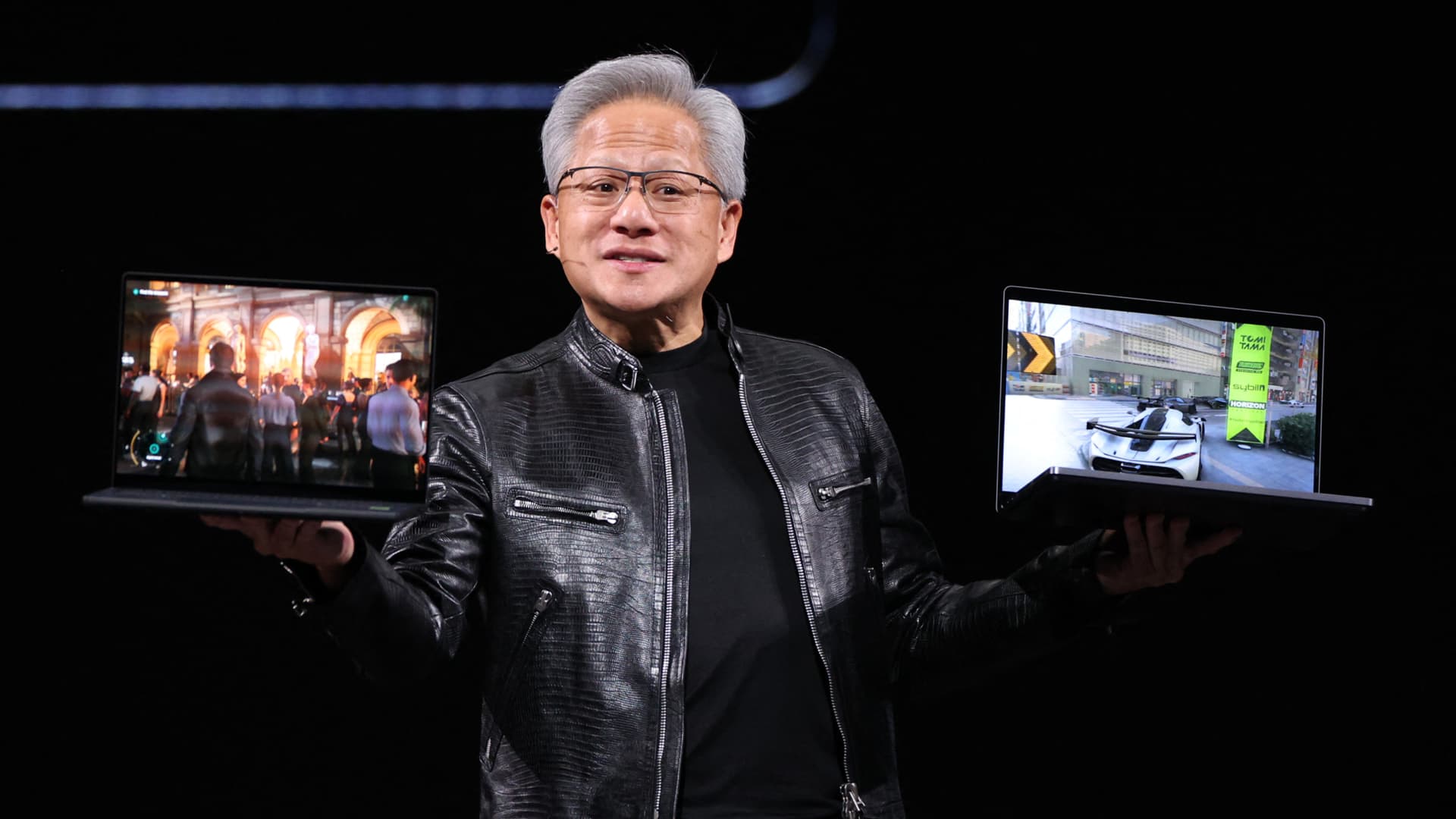
NVIDIA Is Going Straight For Apple’s Lunch
The headline alone should make Cupertino and its investors sit up straighter.
This is not another Windows laptop with a hot discrete GPU bolted into a chassis and wished good luck by the battery department. Nvidia is entering the consumer PC processor market with an ARM-based AI chip family built around local agentic computing, with Microsoft and the major OEMs already lined up.
Apple’s defenders will reach for the usual comfort objects.
Battery life. First-generation caveats. Windows-on-ARM scars. Compatibility. Price. Heat. The old line that Apple does integration properly, while the PC world merely assembles parts and hopes the fans do not sound like a small regional airport.
Some of those questions are fair but the trajectory of this missile is easily projected.
The first RTX Spark machines may be expensive, and aimed more at creators, engineers and local-AI experimenters than normal laptop buyers. Early products in new architectures often arrive with visible seams. Notably, they all run NVIDIA’s development environment directly which will make them immensely powerful tools for high level AI teams.
The sticker price is not the main point. The direction is.
Apple’s silicon advantage was never just about benchmark charts. The deeper advantage was structural.
- Apple could build the chip, tune the OS, manage the memory model, control thermals, optimise developer frameworks, shape the product, and then ship the whole thing at scale through its own retail and services machine.
- That is the architecture the industry spent years failing to match.
- Qualcomm began closing the efficiency gap from below. Nvidia is now arriving from above, with the world’s most important AI hardware and software ecosystem attached.
CUDA is not a footnote here.
It is the cultural and technical gravity Apple does not have in AI developer land. Nvidia already owns the data-centre imagination and it owns the creator and GPU performance story. It owns a large part of the AI software stack by habit, not merely by hardware. Microsoft has wrapped that inside Windows in collaboration with NVIDIA on this project, and if OEMs can ship credible laptops and desktops around it, Apple Silicon stops looking like a private road and starts looking like the first completed lane on a motorway others are now joining at speed.
This does not make Apple Silicon weak. It makes the theology around Apple Silicon weaker.
Apple remains formidable because integration still matters, and Apple is still better than almost anyone at turning complex engineering into something ordinary people can use without thinking about the plumbing.
But Nvidia’s move attacks the comfortable assumption that only Apple can build a consumer machine where silicon, operating system, memory, AI acceleration and developer tooling reinforce each other.
Microsoft has every reason to make this work. OEMs have every reason to want out from under the old x86 stagnation story. Nvidia has every reason to drag its AI empire down from the data centre and into the personal computer before Apple, Qualcomm or anyone else defines the local-agent era without it. And it is also likely looking to eat Qualcomm’s lunch too, with better and cheaper ARM silicon for mobile devices.
The timing is also awkward for Apple.
WWDC is supposed to show whether Apple can turn Apple Intelligence, Siri, Gemini, model choice and on-device inference into a credible agentic platform. At precisely the same moment,
Nvidia is telling the market that the AI PC is no longer a slogan. It is an ARM-based architecture, a Windows partnership, an OEM pipeline, and a CUDA-backed attempt to make local AI performance a mainstream computing category.
Apple spent years proving that integrated Arm laptops were the future. Nvidia has now agreed, and their strategy will be to outflank Qualcomm and not just AMD and Intel. They’ll be after the socket for all mobile devices and laptops in direct competition with Apple.
That is the problem.
This is the most dangerous situation Apple has faced in years - direct parity with its own Silicon project,
I’ll be writing more about this soon.
Meanwhile, over at Apple 3.0. PED published a link today discussing about out how Apple’s RISC decision had “changed everything” and how it would position Apple uniquely, to benefit from LLM and AI demands - just this weekend gone.
This piece by kiraa is fantastic - but sadly redundant. Worth a watch though, if you want to understand why Apple Silicon was Apple’s exceptional advantage. Thanks to Apple 3.0 for the link.
Sadly, that entire thesis is now bunk (even though it is expertly made) , but worth a read as a reminder of the lead Apple had, and with today’s released news, how that lead was just severed, even if not in the immediate.
It looks like Moore’s Law is about to make a return. How quaint!
Tommo_UK, London, Wednesday, 27th May 2026
© 2026 Tommo_UK / tommo.fyi
CONTACTING ME
💡 Reach out to me using the Confidential Drop Box form below.


CONTACT ME DIRECTLY: discreetly (and anonymously if you prefer)